The ACT Education Directorate opted for system-wide adoption of Read&Write and OrbitNote across 91 schools. As a result, they have seen wide-ranging benefits including improved literacy outcomes, reduced anxiety and better staff efficiency. Across the Directorate’s 91 schools, Read&Write currently has 34,000 active student users – that’s 97% of students above Year 3.
- Everway tools have allowed students with diverse needs to access the curriculum
- They're growing usage year-on-year, showing long-term impact and sustainability
The ACT Education Directorate introduced Everway tools as part of its drive to make education more accessible and inclusive. The Directorate chose to roll out Read&Write and OrbitNote to all students, beyond the 17% who require classroom adjustments.
 Read&Write
 OrbitNote
By embedding Everway tools at the heart of our practice, we’re building a culture where every student is equipped and empowered to succeed.”
Supporting students
Over the past decade, the ACT Education Directorate and Everway have built a strong and enduring partnership focused on strengthening inclusive education across the region. As Director of Inclusive Education, Jake Naylor supports staff across the Directorate’s 91 public schools to provide high-quality, inclusive learning experiences for every student from preschool to Year 12.
Reflecting on the collaboration, Jake says: “The partnership between the ACT Education Directorate and Everway has truly been transformative for professional learning in our public schools. This collaboration is aligned with our Disability Inclusion Strategy for ACT Public Schools 2024–2034, which has the goal of ensuring every student is welcomed, valued and empowered to access high-quality education alongside their peers.”
Initially, the Directorate adopted Read&Write as a support tool for individual students, before broadening out to a trial of 12 schools. The positive results led to the Directorate funding Read&Write for all teachers and students.
“From the start we've had a focus on involving families,” says Michelle Van Puyvelde, School Leader C for the Directorate, noting that over 200 parents registered for a webinar hosted by Everway (formerly Texthelp) in May 2020. “It's important that families have access to the tool for their young people at home, because that leads to consistency of learning.”
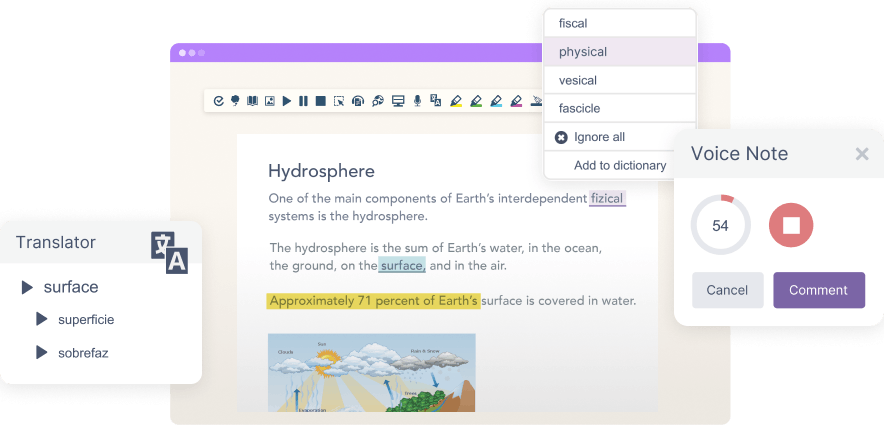
More recently, the Directorate has also introduced OrbitNote – a PDF annotation and accessibility tool – to further support inclusive learning.
Closing the gap
Our data shows that, to date, teachers and students in the ACT Education Directorate have used Read&Write 6.4 million times.
Among the standout features of the toolbar is the speech-to-text feature, which allows students who struggle with writing to get their thoughts on paper without the barrier of spelling. Text-to-speech is a popular support for reading comprehension and proofreading, while the simplify feature streamlines webpages and summarises content to make research more accessible.
OrbitNote has also proven invaluable for making PDFs more accessible, with annotation tools and voice notes offering new ways to interact with documents and provide feedback.
Jake expands on the impact of these tools: “Across all stages, from early childhood to high school, Read&Write and OrbitNote have empowered students with disabilities to access, engage with and demonstrate their learning in ways that were previously out of reach. These tools foster independence, boost confidence and are celebrated by teachers and parents for leveling the playing field and helping every child reach their potential.”
Across the board, this improved accessibility has translated into higher student engagement. This is especially true in secondary schools, where many students start with below average reading skills.
“The amount of reading increases in that step into the secondary curriculum in Australia,” says Michelle. “That's where we see a lot of young people start to disengage. They have challenging behaviour in the classroom and end up in a spiral of getting further behind. So by introducing Read&Write from upper primary into junior secondary school, we are seeing greater engagement.”
Removing barriers
Addressing literacy skills and confidence goes to the core of teaching and learning within the Directorate. It’s about giving students the confidence to know that literacy is no longer a barrier to their learning.
Read&Write and OrbitNote have empowered students with disabilities to access, engage with and demonstrate their learning in ways that were previously out of reach.”
There is a recognised need for a certain level of literacy in other subjects such as maths and science. For students to be able to collaborate and work together in groups, they still need literacy. Michelle views it as “empowering” for students – giving them a tool that will enable them to be successful learners and pursue successful post-school options.
Results from school pilots and feedback from teachers show that Read&Write and OrbitNote have made learning more accessible. They have also increased student confidence in writing, spelling and reading.
Jake shares an example of a Year 5 student with dyslexia who struggled with reading comprehension and spelling. After she started using Read&Write, teachers observed a transformation in her classroom engagement and confidence, while her parents noticed a positive change in her attitude toward reading and homework. The student became more independent and proud of what she could accomplish on her own. “When I use the computer to read the stories to me, I can understand them better and I don’t get as tired,” she said.
Other students shared how Read&Write and OrbitNote had positively impacted their learning, helping them to articulate their thoughts with confidence.
Using these tools helps me share my ideas and be part of the conversation, even when speaking out loud is hard for me. It means I can be heard just like everyone else.”
Independent learning
Schools in the ACT Education Directorate had short periods of remote learning in 2020. This gave teachers an opportunity to delve deeper into the capabilities of Read&Write and how it can help students become more independent. Not only did it provide vital accessibility support for students who require it, but all students could benefit from features such as the highlighters and vocabulary list to aid study, organisation and memory recall.
“By integrating tools like Read&Write and OrbitNote into our activities, we have moved beyond viewing assistive technology as a niche solution,” says Jake Naylor. “Instead, we champion accessibility for all, ensuring every student, regardless of ability, can access and demonstrate their learning in ways that work best for them.”
Inclusive frameworks
Deploying these tools has been key to the implementation of inclusive frameworks such as Universal Design for Learning (UDL) and Multi-Tiered Systems of Support (MTSS). During teacher training, ACT Education Directorate schools focus on developing a shared understanding of these frameworks and how Everway tools can be used to support them. This brings clarity and consistency to their teaching methods and student support offering.
Everway tools not only make UDL and MTSS practical and sustainable, but also help build a school culture where every learner’s needs are recognised and met.”
It’s also key to ensuring intentional use of digital tools. As Michelle notes, it’s important that teachers are not only trained in how to use the tool but how to use it purposefully. “There is always a purpose behind why we’re using Read&Write and why we’re advocating for it so strongly,” she says.
Everway has partnered with the ACT Education Directorate to deliver ongoing professional learning tailored to the Directorate’s needs and goals. These hands-on workshops are aimed at demystifying assistive technology and contextualising it for classroom scenarios and learner profiles. “Everway’s presence at these events has been pivotal,” says Jake Naylor, describing how the team have helped by providing technical support and "actively modelling how to integrate assistive technologies into everyday classroom practice.”
Lasting impact
Since implementing Everway tools across their schools, the ACT Education Directorate has seen an uptick in literacy engagement across age groups. The tools have been invaluable to students with disabilities, giving them accessible learning pathways that were previously unavailable. Educators have observed the impact this has had on students more broadly, noting a growing culture of independent learning.
The senior leadership team also commended how the tools have benefited teachers as well as students. The voice notes feature in particular was highlighted as an invaluable tool for streamlining feedback and facilitating collaboration. Inclusive Education Director Jake Naylor uses OrbitNote to annotate and review PDF policy documents and compile meeting notes.
As part of the Directorate’s strategy to maximise usage and leverage the full benefits of Everway tools, they have set up the Student Voice Forum to capture student feedback. They’ve partnered with the customer success team at Everway to deliver workshops, ensuring they get the most value out of their tools. This has had the added benefit of helping students to become more invested in their learning.
“These forums demonstrate how accessible technology, thoughtful facilitation and a commitment to student voice can transform participation,” says Jake. “By embedding digital tools at the heart of our practice, we are building a culture where every student is equipped and empowered to succeed, and where their voices drive meaningful change in our schools. The partnership with Everway and the voices of students are laying the foundation for truly inclusive education in the ACT.”