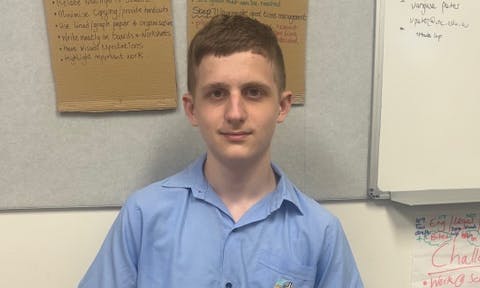
Hamish is a bright and capable student who enjoys maths but struggles to express what he knows. He has Ehlers-Danlos Syndrome, which causes physical limitations including fine-motor difficulties and extreme fatigue. Over the past 18 months, Hamish has used Equatio to access the curriculum. Having seen the impact Equatio has had on Hamish’s learning, Pacific Lutheran School is now deploying the tool to 100 students with identified learning needs.
Hamish is a final-year student at Pacific Lutheran School. He was provided with Equatio to support the needs of his physical disability. 18 months later, he is thriving with the independence the tool has given him. Now his school is supplying Equatio more broadly so that 100 students with identified needs can also benefit.
 Equatio
Equatio has changed my life and I couldn't do what I do without it.”
Meet Hamish
Hamish is 17 years old and in his final year at Pacific Lutheran College (PLS). He has Ehlers-Danlos Syndrome (EDS), a degenerative physical disability that causes fatigue and difficulty with fine motor skills, among other symptoms.
His teachers highlight his academic strengths, describing Hamish as a clever and capable student who enjoys maths.
However Hamish’s condition means that he struggles to showcase the full extent of his knowledge and understanding. It’s difficult for him to handwrite, and up until 18 months ago, he relied on a scribe to capture his answers in exams. This was frustrating for Hamish, particularly as he got older. It led his teachers to seek alternatives that would offer Hamish the accessibility and independence he was looking for.
Discovering Equatio
The school’s Head of Learning Enrichment Chantal McAllister met with Hamish to profile his needs and abilities. This formed the basis of his IEP (Individual Education Plan), and helped Chantal to establish what they required from a support tool.
Hamish felt that he could do the maths, but couldn’t physically show what he knew. Even with the help of a scribe, Hamish would leave exams feeling physically drained. Dictating to a scribe required constant explanation and created a disconnect from the work.
Their discussions concluded that Hamish needed a way to express his mathematical thinking independently and without physical strain.
Chantal first heard about Equatio through conversations with other educators who recommended it as a support for students with disabilities. She was drawn to it because of the assistance it would give to students with physical impairments who struggle to articulate their learning.
I’m always curious about new things that help children with disabilities. Equatio immediately stood out as something innovative."
Chantal identified Equatio as a solution that could remove barriers for Hamish, offering him a way to work through maths problems and demonstrate his understanding without a classroom assistant.
How Equatio supports students like Hamish
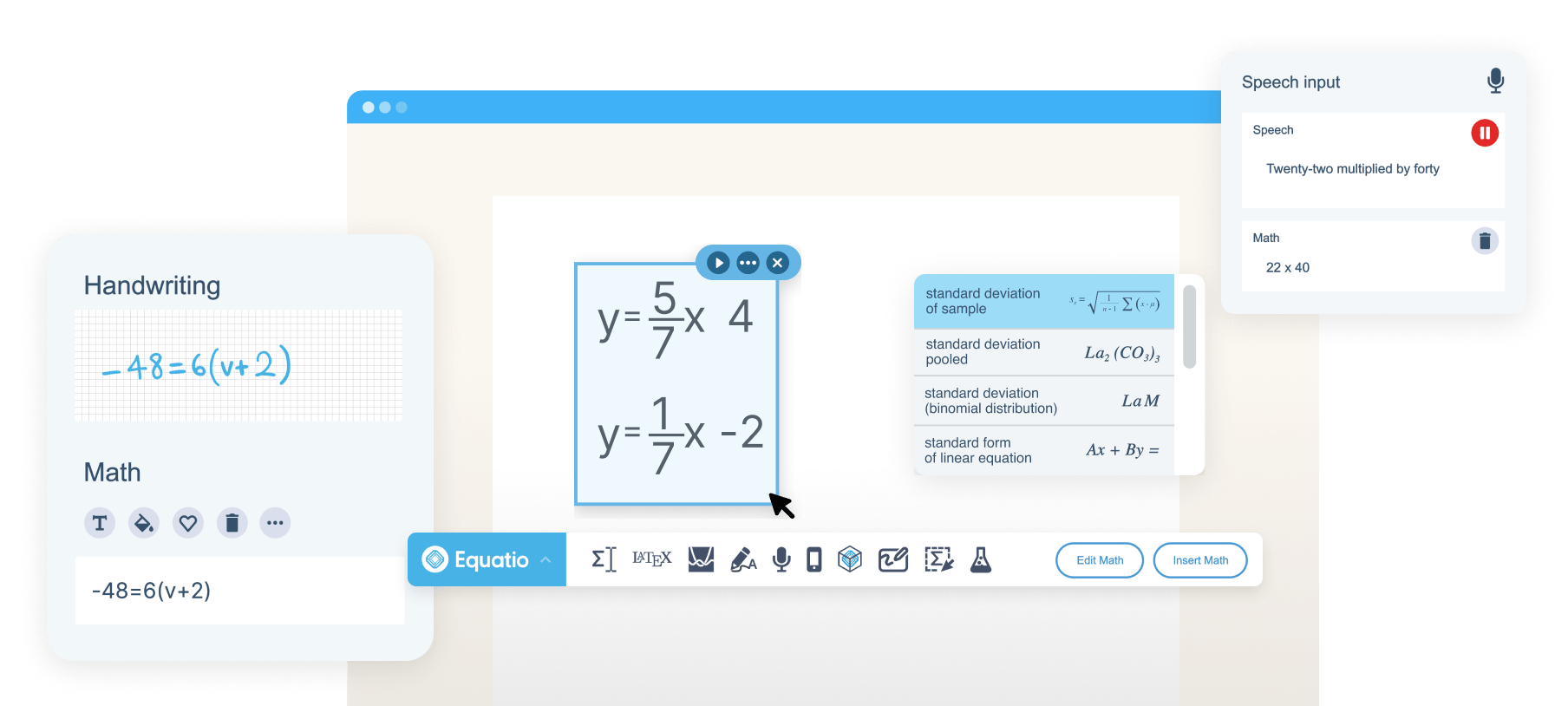
Equatio enables students with physical disabilities, particularly those who experience reduced fine-motor control, pain or fatigue when writing, to demonstrate their maths understanding in more accessible ways.
Instead of relying on handwriting, students can type mathematical expressions, use the intelligent prediction feature to insert complex equations instantly, or speak into their device for Equatio to transcribe what they say.
These features significantly reduce physical strain, letting students focus on problem-solving rather than the mechanics of writing. Students with limited mobility can insert formulae with a single click, reducing the fine-motor effort required.
“Equatio has helped me study for longer periods of time because it’s not as fatiguing,” says Hamish. “I’m now able to stay focused for an entire lesson. It makes doing maths so much easier. I’ve become a lot better at maths because now I can keep up.”
By helping students work through maths problems without physical strain, Equatio ensures they can participate fully in lessons, keep pace with classmates and demonstrate their understanding.
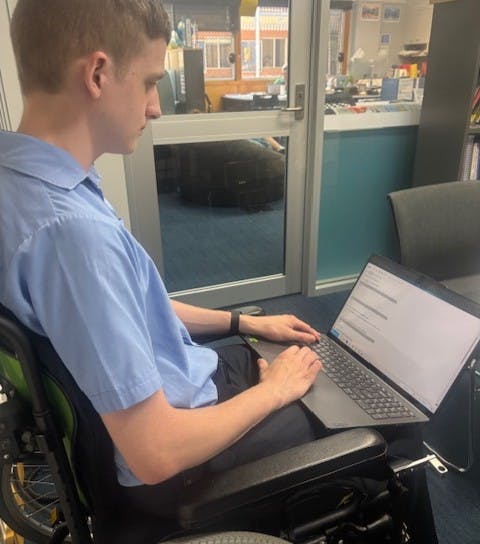
Equatio has given Hamish back energy that would have been spent on trying to write his answers. He now is free to think about what the answers are and to focus on what really matters.”
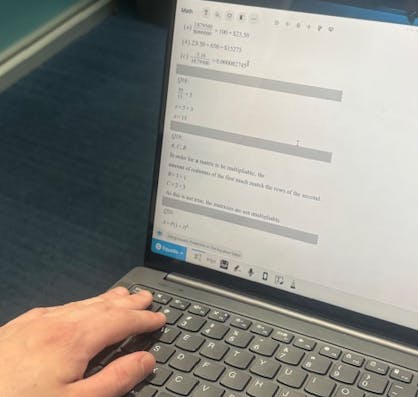
For Hamish, the biggest difference has been in assessments. He is now able to complete maths exams independently using typed or spoken input, allowing him to conserve energy and reduce discomfort.
Chantal explains more: “While we have very good scribes, they still present a barrier. With Equatio, students don’t have to explain to anyone else what they want to write. They can do it themselves. That’s a real breakthrough.”
Learning without barriers
Hamish describes the impact Equatio has had on his school life. Now that he’s able to keep up with lessons and stay focused for longer, his grades have improved. He finds that he is enjoying maths and feels ownership over his work as it’s not being mediated by a scribe. His attitude towards exams has changed, too.
He’s going into the exam much calmer. That pressure, the nervous tension, is gone.”
In the past, when Hamish was writing or using a scribe, he would come out of the exam exhausted. “Equatio’s changed that for him,” expresses Chantal. “He's excited about maths exams! He's getting excellent marks like he always has, and yet he's leaving an exam healthy, happy and very proud of what he's done and feeling like it's his work he was able to express. So that's been really incredible.”
Chantal shares an analogy that Hamish used to describe his condition. “It’s a bit like having a battery pack. If you don't plug it in, it runs down and needs to be recharged. Equatio, for him, is like having that support battery plugged in.”
She continues: “He feels like he has the access he needs to produce his work, to achieve it individually and not feel like he's relying on others or waiting for rooms or special conditions to get to do a specific exam. He just has access on the same basis as his peers, and it's removed the barrier for him. So it's an absolute win.”
Lasting impact
Equatio not only transformed maths learning for Hamish – it renewed his confidence and enabled him to express his thinking independently. Hamish now feels fully equipped to achieve his goal of studying Occupational Therapy at university.
This experience has become a catalyst for broader change at Pacific Lutheran College. The school is strengthening its commitment to equitable exam conditions. For Chantal, her work in disability inclusion has reinforced the importance of giving every student the tools they need to show what they know.
She emphasises the importance of schools understanding the difference between physical limitations and cognitive ability. “When we look at Hamish, we've got a very, very capable student. He's very confident. Yes, he's had a lot of support and he's at the end of his journey and it's really about him being able to be in control.”
PLS has now opted for a group licence so that 100 students with identified needs can benefit from Equatio. By widening access to Equatio, Chantal aims to catch struggling students and prevent them from developing self-esteem issues that block them from pursuing learning or discovering all they are capable of achieving.
However she recognises that many students who struggle physically or cognitively may not have a formal diagnosis. Many more may never have asked for help. This is why increasing numbers of schools are deploying a whole-school rollout of accessibility tools like Equatio and Read&Write.
If it's rolled out so everyone has access to it, we'll be picking up kids we don't even realise they need it.”
Investing in Equatio is not just about supporting access for a few. It’s about getting all students effectively engaged in their education. Hamish believes that tools like Equatio are valuable for all students, not just those with disabilities.
By supporting efficient expression and easing cognitive load, Equatio offers benefits to all learners. A whole-school approach means students can self-serve, without needing to label themselves as different.
In Hamish’s case, the support from Equatio has been life-changing, and an example of how the right tool, used at the right time, can unlock a person’s potential.
Hear from Hamish
Hamish shared with us his experience of using Equatio – including his favourite features, how the tool had impacted his learning in the past 18 months, and his thoughts on how students more broadly could benefit from the tool.