
Read&Write has allowed students with diverse needs to access the curriculum on equal terms with their peers.
- 12,500+ students actively using Read&Write across the Diocese
- System-wide adoption across 45 schools, supported by Inclusion Officers and training programmes
- Growing usage year-on-year, showing long-term impact and sustainability
The Diocese of Lismore Catholic Schools accommodates 18,000 students across 45 schools. Around 18% of students are receiving adjustments.
 Read&Write
We want to reduce learning barriers and give everyone choice in their learning.
A diverse student population
The Diocese of Lismore Catholic Schools accommodates 18,000 students across 45 schools. Those schools are spread over a wide area in both urban and rural locations. The student population varies, some areas are more culturally diverse than others. Some have a higher percentage of indigenous students while others have more English as a Second Language learners.
Around 18% of students are receiving adjustments. Many students have a diagnosis but others will be based on assessment by teachers and other professionals. All of these students are included in the Nationally Consistent Collection of Data (NCCD).
Developing a system-wide approach to technology
“The usage of devices varies from school to school and grade to grade. Some schools have shared devices, some ask kids to bring their own and some have one device per student. All secondary schools in the diocese have 1 to 1 devices,” says Kara Collyer, an Inclusion Officer from the Diocese of Lismore Catholic Schools Office.
“We developed a system-wide approach to assistive technology to support learning and teaching,” comments Kara. "We wanted a tool that could be adapted and used by all students and all teachers, in all settings. The goal was to reduce the barriers students face when accessing the curriculum."
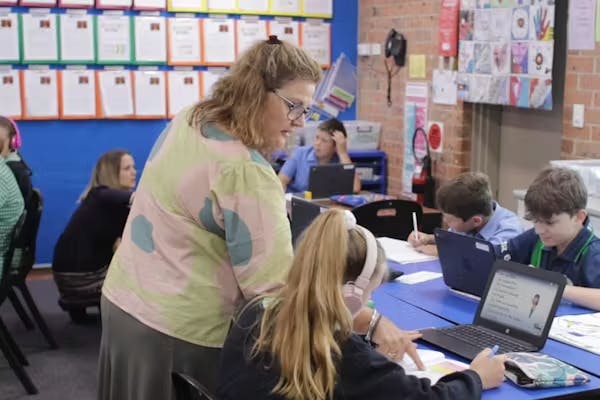
Lismore opted to implement Read&Write across their schools.
“Students with learning disabilities have benefited the most from Read&Write," says Kara. "It has allowed them to engage with text and access the curriculum on the same basis as their peers without looking different. Which is important to lots of students. It has also helped teachers provide adjustments that let all students access the curriculum in a way that suits their learning needs."
Read&Write stood out because we wanted something that would work across platforms and could be used on various devices.
“It makes the learning more accessible, but it also requires the teachers to lead the technology and be able to use it themselves. Technology provides adjustments for students to access the curriculum in different ways that suit their learning profile and preferences, like text to speech, videos and instant feedback.”
How Read&Write is making a difference
As of 2025, there are 12,500 students using Read&Write across the Diocese. That's 69% of the student population. When we look at how many times the toolbar has been used to perform a task, that number is a massive 2.5 million uses.
The voice notes tool is very popular, as teachers can give quick and accessible feedback to students. The students also use voice notes to collaborate on projects, finding it an effective way to explain their thoughts.
Giving all students access to tools fits with the Universal Design for Learning principles enacted within the Diocese. As Kara says, “we want to reduce learning barriers and give everyone choice in their learning."
Lasting impact
After a successful trial, the decision was made to widen access to the software across all schools in the Diocese, and data shows that usage is going up and up.
Inclusion Officers like Kara provide training on Read&Write. They have built their own capacity to roll out training on assistive technology for all teachers. During the Covid-19 lockdowns they were able to provide training to Teacher Assistants too, to make sure everyone knew how to use tools to support learners. Kara mentioned that they do “Sand Pit Sessions” where teachers can drop in, have a look at three or four tools, try them out and then go.
What’s next for Kara and her team?
Kara's goal is to make sure all teachers and students know that the tools are available for them to use whenever they need. The Inclusion Officers also deliver training to all recently qualified teachers - what better way to make sure everyone starts off with Universal Design for Learning at the heart of what they do?