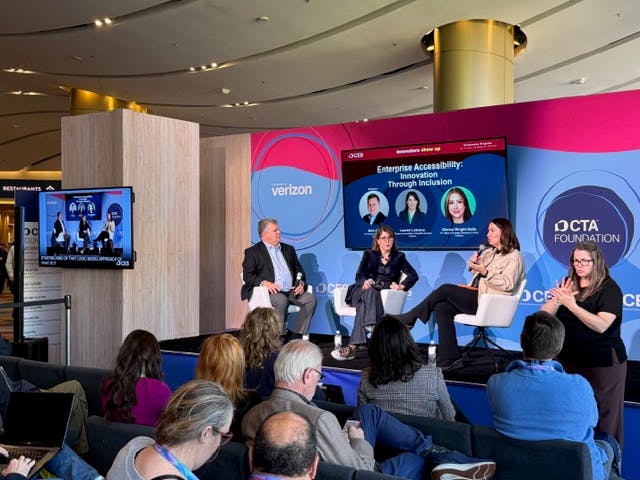
Last week at CES, surrounded by the flashing lights of next-generation gadgets and the buzz of future tech, I had the privilege of sitting down with Lauren Lobrano from Amazon and Matt Ater from Vispero. Our panel, Scaling Enterprise Solutions for Inclusive Workplaces, wasn’t just about the latest software or hardware. It was about a fundamental shift in how we view human potential.
We posed a question to the room that I want to pose to you now: If accessibility only works when an employee asks for help, how many capable people are already falling behind?
For too long, the corporate world has treated accessibility as an exception - a ticket you file, a form you sign, a reactive measure for a specific individual. But as we discussed on stage, accessibility fails when it is treated as an exception. It only succeeds when it is treated as enterprise infrastructure.
The friction signal
One of the most important things we discussed was how "friction" - that feeling when a tool or process is hard to use - is actually a warning sign.
As a person with a disability, I often experience friction in a system early. In practice, this is rarely just an "edge case" or a personal problem. It is usually a preview of where systems will break at scale. Employees who encounter barriers first are often identifying system weaknesses long before others notice them.
Organizations that listen to this feedback improve their products and processes for everyone. Those that ignore it create environments that require more effort, cause more fatigue, and create unnecessary barriers to doing good work.
This is not a small issue. One in four adults in the U.S. has a disability. Neurodivergence exists across every industry, age group, and community. Yet, research shows up to 76% of neurodivergent employees do not disclose a condition.
When support depends on you raising your hand and disclosing a diagnosis, organizations are designing for only a fraction of their workforce.
From "one-off" to "day one"
So, how do we move from reacting to problems to preventing them?
Lauren shared how Amazon addresses this by treating accessibility as part of how the company operates. On "Day One," employees can access tools like JAWS or Read&Write through the internal software store. They don't need to fill out forms, get approvals, or prove they have a medical need.
That approach removes delays, protects privacy, and shifts accessibility from a "special request" to a standard tool. It also creates consistency across teams.
Matt Ater from Vispero highlighted why this matters for the IT and security teams, too. For years, companies bought assistive technology one license at a time, usually when someone asked for it. That led to security gaps, multiple different versions of software, and uneven support. In big organizations, if tools aren't deployed consistently, even basic troubleshooting becomes impossible.
Centralized, enterprise-wide solutions reduce cost and risk while making sure support is reliable and ready to scale.
From accommodation to innovation
The most forward-thinking companies are realizing that technology designed for accessibility consistently outperforms narrow design because it works for everyone.
There is a concept in design known as the "Curb Cut Effect", the idea that features designed for disability often become essential for the mainstream population.
According to research from Disability:IN and EY, employees with disabilities are often the fastest adopters of digital tools because these tools help them work more smoothly. However, most workplace tools are still designed with an emphasis on speed over comprehension.
Take AI as an example. It's becoming embedded in daily work, but instead of reducing friction, these tools can create additional effort for neurodivergent users. That’s because they are built on the assumption that everyone works and engages with information in the same way.
At Everway, we know this isn’t true.
People think, process, and communicate in different ways - and technology works best when it is designed to reflect that reality. These observations directly inform how we build our products and where we choose to innovate.
The collective opportunity
Disclosure is increasing because expectations are changing, not because disability is new. Employees now expect systems to adapt to them, not the other way around.
The opportunity ahead is for all of us. Employers, technology providers, and employees all have a role to play in building systems that work for more people. That includes:
- Involving and compensating people with disabilities in testing and design.
- Reviewing hiring and performance systems to remove unnecessary barriers.
- Treating accessibility as a core business strategy.
Organizations that build support into their infrastructure will be better positioned to attract talent and reduce risk. Those that rely on self-advocacy alone will continue to miss capable people who are working around barriers quietly.
We have to keep asking: if our workplace tools only help people who ask for accommodations, how many capable colleagues are we leaving behind?