Everway for Work AI

Many AI tools prioritize speed. Everway for Work prioritizes people. We use secure, neuroinclusive AI to support focus and clarity, without replacing human judgement or increasing pressure.

Our privacy-first approach meets ISO standards and full GDPR compliance. Data is encrypted, never stored long term, and never used to train AI models.
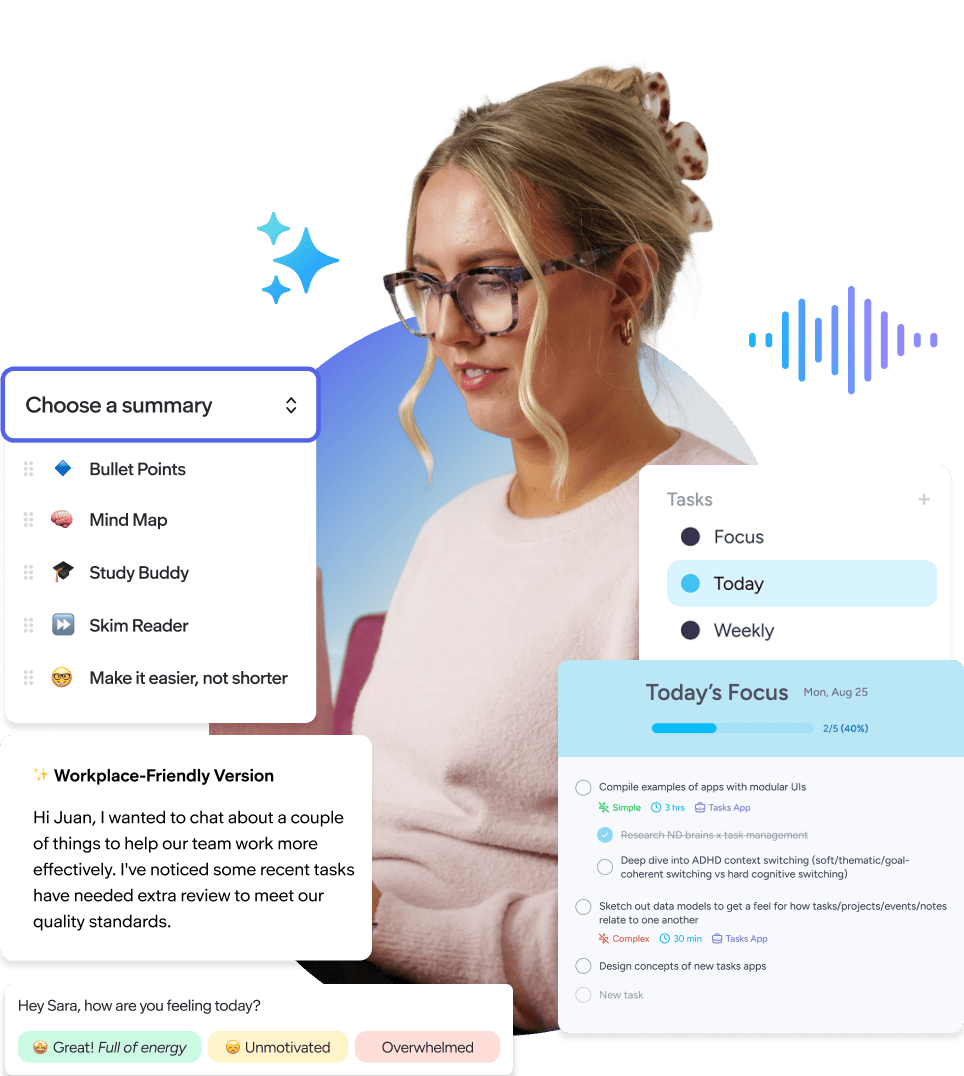

An employee surrounded by product ui of AI features within Read&Write and Mindview

The Everway approach to AI

A human-first approach

AI should support people, not replace them. Our tools are designed to work alongside human capabilities, with people always at the center.

AI acts as assistive support, helping individuals pursue their own path to success.

Protecting user data

Trust is essential. We prioritize strict data security and user safety, choosing not to compromise on protection simply to follow industry trends.

Our focus is on creating safe, inclusive spaces where people can use our tools without worrying about how their data is handled.

Tackling bias in AI

Accessibility underpins everything we do.

Our AI is designed to support diverse needs and promote fairness through careful model selection, testing, and validation, alongside safeguards that help minimize bias and maximize inclusion.

Investing in the future

We’re excited about the potential of generative AI and are actively investing in responsible AI research and development.

Alongside the neuroinclusive features we deliver today, Everway maintains a dedicated AI and Gen AI roadmap to ensure our products evolve safely, responsibly, and with people at the center.

Executive summary

Infinity loop logo

Everway for Work: product overview

Everway for Work is a suite of neuroinclusive tools designed to help all employees process information, communicate clearly, and stay organised across the flow of work.

It brings together complementary products that support different thinking styles, working patterns, and roles - without forcing people to adapt to rigid systems.

The Everway for Work suite includes:

A smiling employee in an office working at a computer
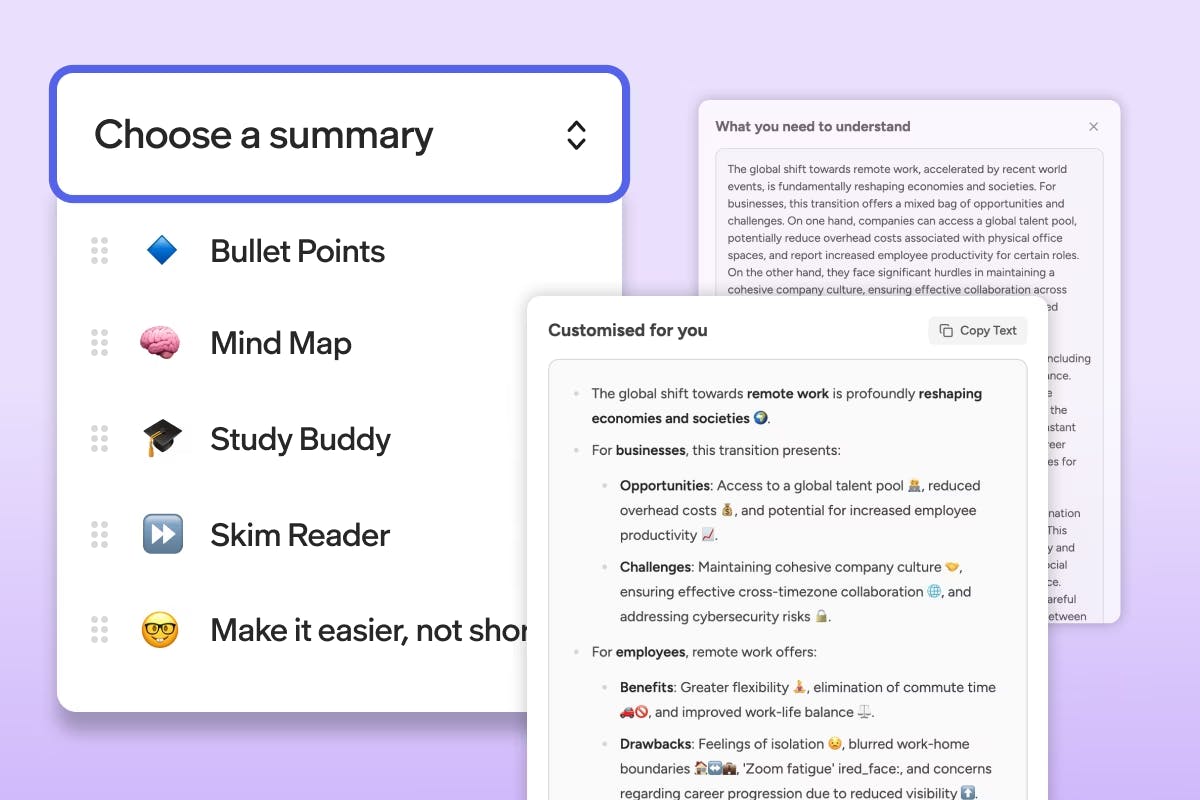
UI screenshot of Readwrite for Work srummaries feature

Read&Write for Work

Tools that boost understanding, support clear expression, and enhance collaboration

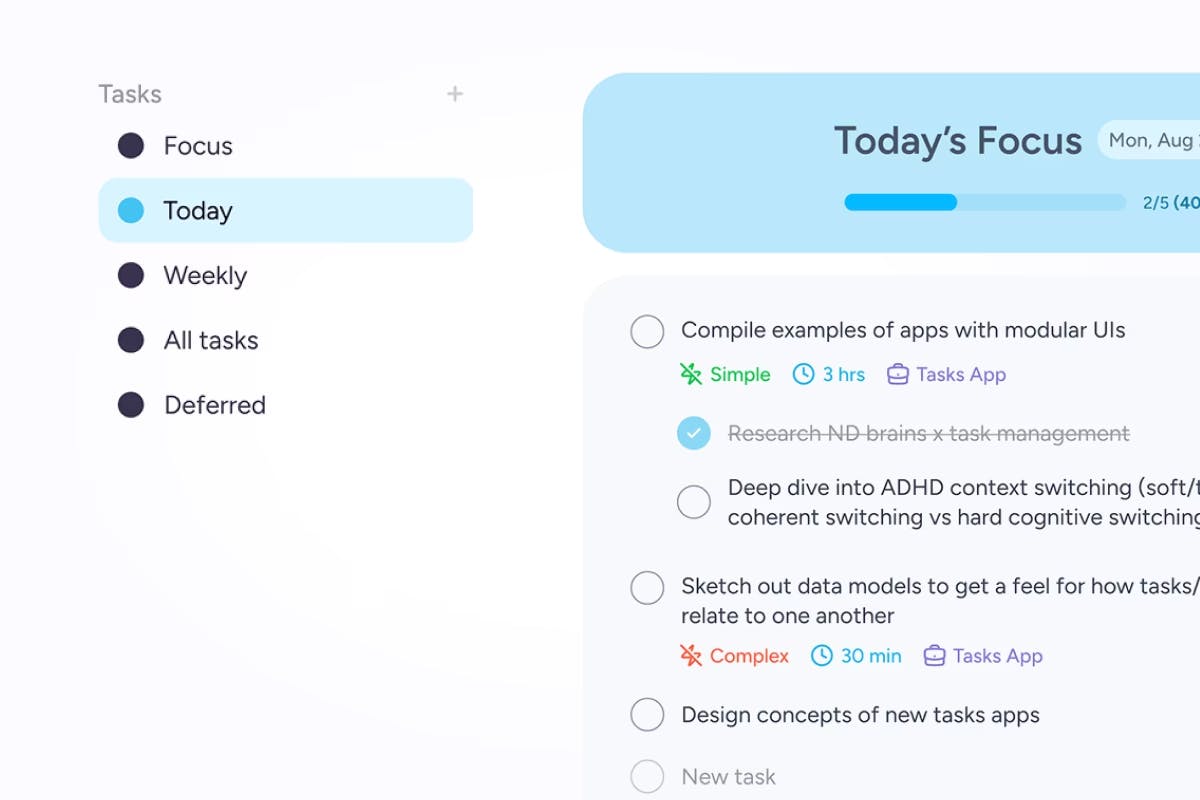
Product UI screenshot of structured tasks lists feature

Tasks

A neurodivergent‑friendly task management platform that helps employees manage workload, reduce overwhelm, and maintain momentum

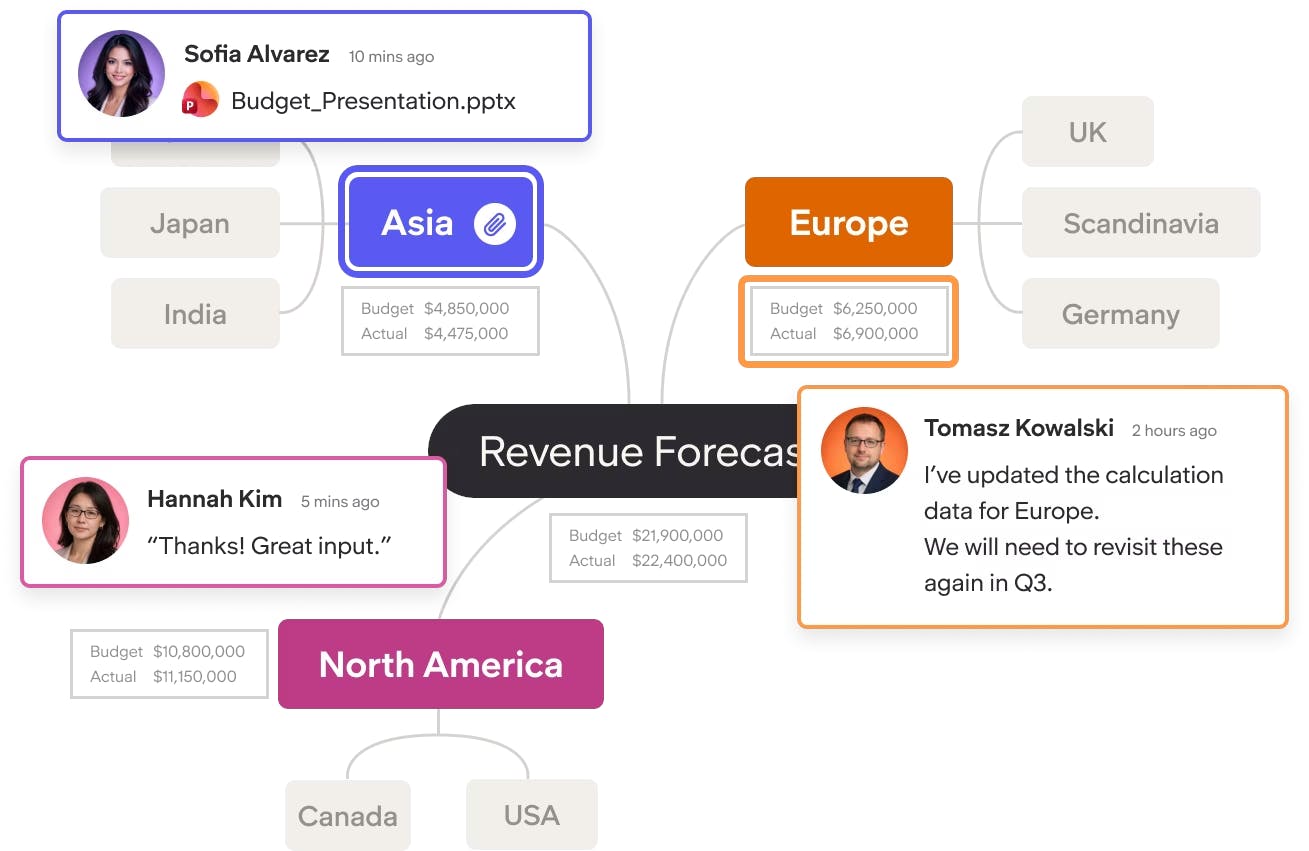
Decorative illustration of a MindView collaborative mind map with regions, numbers, and comment cards representing teamwork and planning.

MindView

A structured visual planning tool that helps users break down complex ideas into clear, actionable steps

Each product uses AI differently, based on what best supports user trust, safety, and outcomes.

Neurodivergent employees are 55% more likely to use AI at work.

Yet most AI tools are not designed with neurodivergent people in mind.

Neuroinclusive AI

Many AI solutions focus narrowly on speed and efficiency. Everway for Work takes a different approach.

We use neuroinclusive AI designed to enhance focus, clarity, and cognitive performance - not to replace human judgement or pressure people to work faster.

We apply AI only where it genuinely helps, with care, responsibility, and real people in mind.


AI use in the Everway for Work suite

Read&Write for Work

Reading, writing and translation support for confident communication.

MindView product icon

MindView

Visual planning and mind-mapping tools for flexible thinking.

Read&Write for work logo

Read&Write's AI is on‑device by design - for Refine and Summaries

Read&Write highlighters being demonstrated on a laptop

That means:

  • All AI processing happens locally on the user’s device
  • No data is sent to the cloud
  • No prompts, documents, or user inputs leave the device

This architecture exists for one reason: to serve organisations that cannot use cloud‑based generative AI.

It is a privacy‑first, security‑first approach, purpose‑built for accessibility and assistive use cases where trust, control, and compliance matter.

This makes Read&Write suitable for highly regulated, security‑conscious, and data‑sensitive environments.

Frequently asked questions

No. All AI processing happens locally on the user’s device.

Read&Write does not send prompts, documents, or user input to cloud-based AI services. The language model is downloaded and stored locally, and all inference happens on-device. There are no background API calls, no remote processing, and no data egress.

Key points:

  • No OpenAI, Google Cloud, Azure, or other AI APIs
  • No prompts transmitted externally
  • Works offline once installed

No. Never.

The models used by Read&Write are static, pre-trained models. User data is processed in memory on the device and is not logged, stored, or reused for training - by Everway or by any third party.

Important clarification for procurement and security teams:
Even if a customer explicitly wanted their data used for training, the architecture does not allow for it.

Read&Write uses Google’s Gemma 3, a modern open-weights language model designed to run efficiently on local hardware.

Everway validates all models for:

  • Safety and alignment
  • Performance on supported devices
  • Compatibility with accessibility and assistive use cases

Using an open, locally hosted model reduces dependency risk and avoids reliance on opaque, constantly changing cloud models.

Most AI tools send text to a cloud service every time they are used. Read&Write does not.

Read&Write runs AI features directly on the device using a local model. An internet connection is required once to download the model. After that, AI features can run entirely offline.

Air-gapped environments:
Devices with no internet access cannot download the model using the standard setup. Options such as bundling models with the installer are being explored.

On-device processing significantly reduces compliance risk.

Because Read&Write does not transmit or store AI input externally:

  • There is no data transfer to third countries
  • There is no reliance on third-party AI subprocessors
  • The scope of DPIAs and security reviews is reduced

This architecture aligns well with GDPR principles such as data minimisation and purpose limitation.

Final compliance decisions should always be made by the customer’s legal team.

Yes.

Read&Write’s AI features are delivered as part of a managed framework. Organisations retain control over deployment and feature availability, supporting pilots, phased rollouts, and alignment with internal security policies.

Read&Write’s AI features are designed as assistive tools, not decision-makers.

Outputs are suggestions that users can review, edit, or ignore. There is no automatic submission, publishing, or enforcement of AI-generated content.

Models are selected and validated specifically for on-device execution.

While AI features use local computers, they are designed to run efficiently within normal device constraints. Minimum system requirements are clearly defined, and performance is continuously monitored.

Yes.

On-device AI is a strategic choice for Everway. While new technologies are continually evaluated, privacy-first, customer-controlled AI remains a core principle of the Read&Write platform. Customers retain control over AI feature deployment and configuration.

mindview logo

MindView uses cloud‑based AI to support structured thinking, planning, and idea development.

Unlike Read&Write, which runs AI entirely on‑device, MindView’s AI features:

  • Require an internet connection
  • Process data in the cloud
  • Are designed for flexibility, enterprise control, and configurability

This approach enables advanced summarisation and planning features while still maintaining strong controls around privacy, security, and compliance.

An Everway team member on a virtual meeting

Frequently asked questions

Yes.

MindView AI transmits data to OpenAI via a proxy, which anonymizes user identity and controls data flow. The content of prompts, documents, and audio files is sent as-is.

The MindView AI processes data based on geographic location. The following regions are supported. 

User Geolocation: North America, South America,  Australia/Pacific

Datacenter location: East US (Virginia)

User Geolocation: UK, Ireland

Datacenter location: UK-south (London)

User Geolocation: EU, World

Datacenter location: Europe-west (Netherlands)

No.

Data is processed only to generate responses or summaries. It is not stored or reused for training by Everway / MatchWare or by OpenAI.

Yes.

AI access can be disabled at the organisational level and managed through administrative controls, allowing customers to align usage with internal policies.

Yes.

MindView supports configuration of custom OpenAI API keys and endpoints, giving enterprises greater control over how and where AI processing occurs. Details are available in the AI Technical Specification.

No.

MindView’s AI features require an internet connection because AI inference occurs in the cloud. Without connectivity, AI features are unavailable, though core MindView functionality remains usable.

MindView AI is designed to support GDPR compliance.

  • Data is processed only temporarily
  • Data is not stored or used for training
  • A Data Processing Agreement is in place between MatchWare and OpenAI LLC

Customers should still carry out their own DPIA and legal assessments.

Yes. All communication between MindView AI, the proxy service, and OpenAI uses industry‑standard TLS encryption.

Only automated systems involved in generating AI responses have access to the data.

No human review is performed by Everway / MatchWare or by OpenAI.

Minimal impact.

Because processing occurs in the cloud, local device performance remains consistent with standard MindView usage.

AI assistance is included in MindView licensing.

Future or advanced AI capabilities may be subject to separate terms.

AI-generated content is presented as suggestions for users to review and edit. Users remain in control of what they accept into their mind maps.

Yes.

Everway / MatchWare continues to enhance MindView AI while maintaining customer control options such as feature disablement and custom endpoints.