Adoption impact study
Closing the achievement gap with Read&Write at Plymouth-Canton Community Schools
Plymouth-Canton schools see measurable increase in district wide reading assessment with the use of Everway's Read&Write.
The report
An impact study was conducted by the Assistive Technology team to measure the impact on learner achievement and closing the gap for low growth, low achievement students. This was measured by comparing the district’s scores in the NWEA’s MAP reading assessment, before and after Read&Write was introduced, over the course of two years.
We break down the results into three sections:
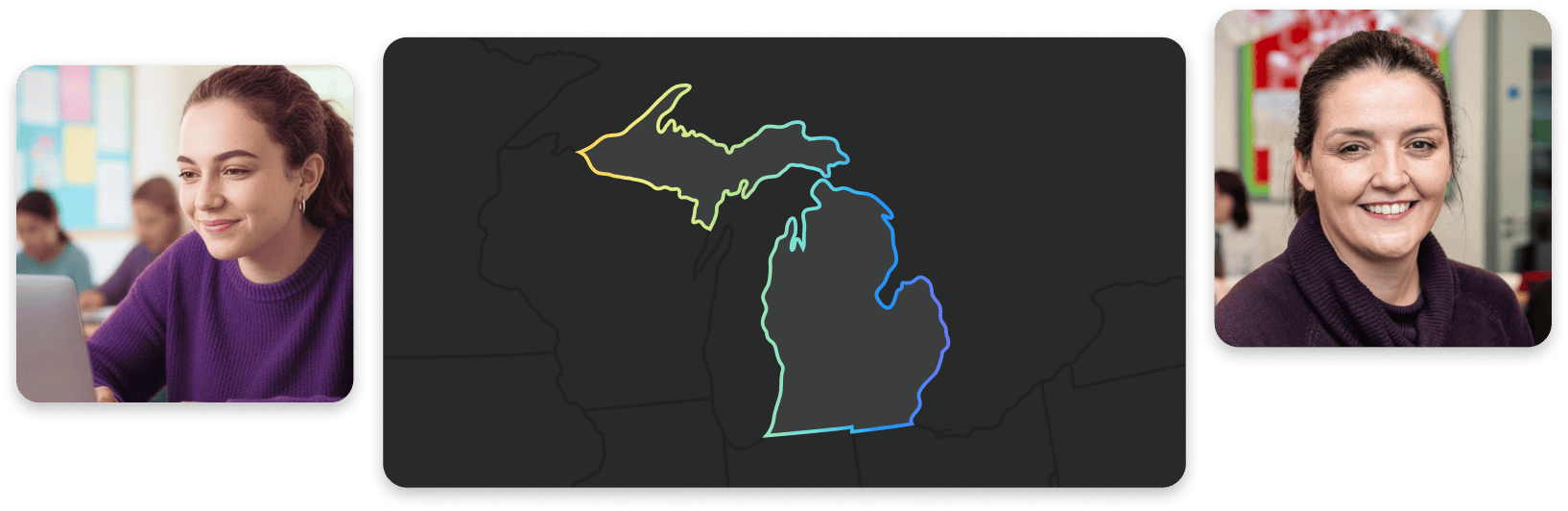
Plymouth-Canton Community Schools is the fourth largest district in Michigan, with 18,000 students spread across 14 elementary schools, 5 middle schools and 4 high schools.
Running a 1:1 device program, each of these students in grades K-12 have access to either an iPad, Google Chromebook or the option to bring their own device to school. Around 10% of students at Plymouth-Canton are students with Individual Education Plans (IEP), in addition to the 10% of students who are English language learners (ELL), speaking up to 60 different languages.
The large student population coupled with a diverse range of learning needs, led district leaders to search for a solution to help close the achievement gap for IEP, ELL and students who don’t receive support but who may be struggling. Stacey Banks, Teacher and Assistive Technology Consultant for Plymouth-Canton Community Schools:
“As a part of our district’s dynamic plan we are always continuing to work on closing the achievement gap for all of our students. We want to make sure that we are able to provide learning opportunities that are accessible and effective for all students, incorporating Universal Design for Learning (UDL) principles as a key component to address academic barriers and empower all of our students, not just those who may be struggling.”

2. Supplying access, implementation and adoption

They first selected a 90 day district-wide Read&Write pilot to encourage use amongst all students, staff and teachers.
The district also decided to purchase a group license of Read&Write for use with 150 of their Special Education students. Access to the free features of Read&Write was maintained post-pilot for all other students as a way for Plymouth-Canton to minimize any stigma for their Special Education students.
The decision to purchase Read&Write across the district would ultimately be based on its proven ability to help every student, so usage had to be measured across all students, not just sub groups. To carry out this exercise and begin to gather this important data, the next step involved seeing how Read&Write could improve the district’s scores on the NWEA’s MAP assessment.
After the fall assessment in 2017, grade 3-5 students at one of the elementary schools were provided with access to the full suite of tools within Read&Write. This involved training for students, teachers & media specialists and supporting & encouraging teachers to integrate these tools into lessons at least three times per week.
A second elementary school was then selected to act as a control group to benchmark against, providing an opportunity to directly compare outcomes between students at the same grade level but with different levels of access to the Read&Write tools.
Stacey and her colleagues also selected a sample group from the school using Read&Write by looking at MAP data to identify third grade students who fell into the low growth, low achievement quadrant. This was to determine if Read&Write could help bridge the achievement gap for them.
3. Student outcomes and impact findings
“The data told us that although both schools were growing, the school using Read&Write was growing at a much faster rate.”
Now with one school using Read&Write and one comparison school, Stacey and her colleagues were able to analyze the results from the Winter MAP reading assessment.
- The school using Read&Write achieved a 10 percentile growth vs a 1.4 percentile growth at the control school.
The sample group also saw additional gains after using the full suite of Read&Write tools between the Fall and Winter assessments:
- Low growth, low achievement students’ scores increased by almost 1/3
- From 4.4 points in the Fall to 12.06 points in the Winter
- With many of the third grade students having as many as 30 growth points in that 2017/18 school year
Future proofing and growth
Having this measurable growth data enabled the Assistive Technology Team to make a case to stakeholders for a second year purchase, which involved acquiring Read&Write for a second school.
“We explained how Read&Write could be part of our district-wide dynamic plan - for one UDL tool that supports all of our students. We also focused on leveraging Read&Write to increase our 1:1 participation especially since we were using more digital resources.”
During 2018/19 an additional elementary school was chosen specifically because it had the highest population of English language learners (approx. 22%).
Throughout that year Stacey and her team applied the same methodology with Read&Write within the two schools as they had with year one and “saw differences and growth that we felt could be attributed to Read&Write along with solid instructional practices and our great teachers.”
Since then the usage of Read&Write has continued to grow within the district, from a base of 32,000 events in September 2019 to consistently exceeding 100,000 events throughout the rest of that year, into 2020.
They presented the two years of grade 3-5 MAP growth data, resulting in the approval of a district-wide purchase of Read&Write for every single student in the district who now have access to all the tools to help address any barriers they might have and push them even further.
“We've been pleased to see that our students are continuing to access these tools as they ease in the transition of remote learning and as a district we have found ourselves extremely fortunate to have a solution in place already that addresses accessibility for all of our students.
"It's really one less thing for us to have to worry about when building our remote learning plans at a district level.”