Math and STEM support for students and employees

Math and STEM subjects can present real challenges for many learners and professionals. Through accessible math and STEM tools, we help students in education and employees in the workplace engage with mathematical content, build confidence and reach their potential.

Our solutions are designed with neuroinclusion in mind, supporting a wide range of learning and working needs.


A teacher and a student using a laptop
Two students using Equatio

Math and STEM support explained

Our approach to math and STEM tools centers on flexibility. We give students and employees multiple ways to interact with mathematical content, whether that's typing, speaking, or drawing. Our solutions work alongside existing platforms and teaching strategies, supporting both individual needs and whole-class or team environments.

Key principles:

  • Tools adapt to the user, not the other way round
  • Supports learners in education and employees in the workplace
  • Works alongside existing teaching strategies and workplace workflows
  • Designed with neuroinclusion at its core

Math and STEM tools for students and employees

Our math and STEM software supports independent access to mathematical content in education and the workplace. Explore the tools that make math more accessible.

Equatio logo

Math writing software and math editor

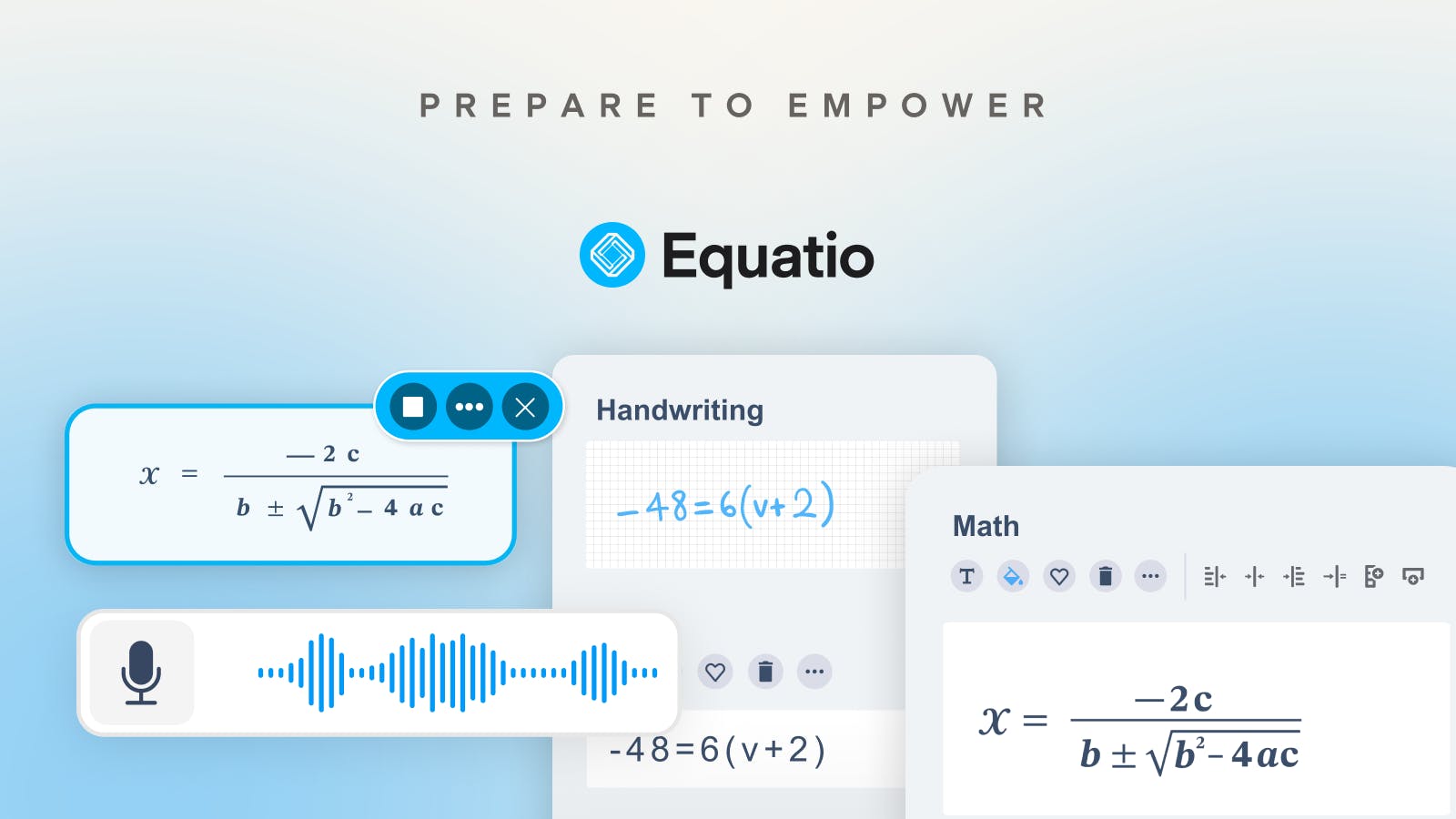
Equatio makes creating and reading math easier. Students can type, speak, or draw equations that convert into clear digital format, and equations can be read aloud to reduce the load of dense notation.

Key features:

  • Online equation editor and LaTeX editor
  • Text-to-speech reads equations and math content aloud
  • Desmos graph creator for visual representation
  • Students can interact with math by typing, speaking, or drawing
  • Works within Google Docs, Forms, and other digital tools
  • Supports creation of digital math assessments and quizzes

Equatio logo

Math writing software and math editor

Equatio makes creating and reading math easier. Students can type, speak, or draw equations that convert into clear digital format, and equations can be read aloud to reduce the load of dense notation.

Key features:

  • Online equation editor and LaTeX editor
  • Text-to-speech reads equations and math content aloud
  • Desmos graph creator for visual representation
  • Students can interact with math by typing, speaking, or drawing
  • Works within Google Docs, Forms, and other digital tools
  • Supports creation of digital math assessments and quizzes

Common challenges students face in math

Many students find parts of math hard at some point. That doesn’t mean they can’t learn it. It often means they need more time, a different explanation, or another way to access the same idea. Some of the most common challenges when teaching math include:

Child smiling while pointing to a flashcard during a classroom learning activity.
  • Increasing complexity: topics move on quickly and some learners need more time to process new ideas
  • Gaps in foundations: missing earlier skills makes later concepts feel confusing
  • Fear of failure: students may worry about getting answers wrong in front of others
  • Math anxiety: past experiences can make math feel stressful before the lesson even starts

Why use technology in math instruction

Assistive technology can help make math more visual, more interactive, and more accessible. It lets students explore ideas in different ways, and gives teachers flexible tools to support a wide range of needs.

Thoughtful use of technology can:

  • show abstract concepts in more concrete and visual ways
  • provide immediate feedback so students can learn from mistakes
  • support different input methods, like typing, handwriting, or voice
  • help teachers personalise practice and track progress
  • remove some of the barriers for students who struggle with writing, reading, or organisation
A classroom of young students using laptops

Neurodiversity and math learning

Every classroom includes students who think and learn in different ways. Neurodiversity is the idea that brains work differently, and that these differences are part of natural human variation, not problems to “fix”. Neurodivergent students might include those with:

Dyslexia mainly affects reading, spelling, and processing written language. In math, this can make it harder for students to read numbers and symbols, follow the language used in word problems, or hold multi-step instructions in mind. They may fully understand the mathematical idea but struggle to show that understanding when tasks rely on reading or writing. Extra time, clear explanations, and visual support can help students focus on the math rather than the literacy load.

Dyslexia mainly affects reading, spelling, and processing written language. In math, this can make it harder for students to read numbers and symbols, follow the language used in word problems, or hold multi-step instructions in mind. They may fully understand the mathematical idea but struggle to show that understanding when tasks rely on reading or writing. Extra time, clear explanations, and visual support can help students focus on the math rather than the literacy load.

Resources for math and STEM educators

Learn more about dyscalculia, assistive technology for math, inclusive STEM classrooms and supporting neurodivergent learners with our math and STEM insights and resources.

Deep dive math topics

Our math and STEM tools are part of a broader commitment to accessible, neuroinclusive learning and work. Explore additional solutions that support diverse learning needs and accessible environments.

ADHD support

Support for students and employees with ADHD with tools that improve focus, reduce distractions, and support organization.

Dyslexia support

Our literacy software removes barriers to reading and writing with tools like Text-to-Speech, spell checking and more.

Autism support

Our tools support communication and information processing with Text-to-Speech, Screen Masking, and tools that help structure ideas.

Special education

Digital tools designed to support individualized instruction and accessible learning for students with diverse needs.

Universal Design for Learning (UDL)

Solutions aligned with UDL principles that provide multiple ways to access, engage with, and demonstrate learning.

Assistive technology

A range of digital tools designed to remove barriers and support independence in learning and work.

What sets Everway apart

Get in touch

Get in touch to learn how our math and STEM tools can support students and employees with diverse learning needs.

Math and STEM support FAQs

A math editor is a digital tool that allows students and employees to write, edit, and display mathematical expressions in a clear, structured format. Equatio is Everway's math editor. Students can type, speak, or draw math expressions, removing the barrier of traditional written notation and making math more accessible for everyone.

Text-to-Speech reads mathematical content aloud, helping students engage with equations, problems, and instructions without relying solely on reading. This is particularly useful for students with dyscalculia or dyslexia, where processing dense written content can make math harder than it needs to be. Equatio and Read&Write both include text-to-speech support for math content.

Dyscalculia affects how people process numbers and mathematical concepts. Providing flexible ways to interact with math, such as allowing students to speak or draw expressions rather than write them, can make a significant difference. Tools like Equatio and Equals Mathematics are designed to support students with dyscalculia by reducing barriers and building foundational math skills at their own pace.

Everway offers a range of math tools for students with disabilities, including Equatio for accessible equation editing, Equals Mathematics for multi-sensory math learning, OrbitNote for accessible PDF worksheets, and Read&Write for reading support across math and STEM content. Together these tools support a wide range of learning needs in the classroom.

Assistive technology for math refers to tools that help students and employees engage with mathematical content more easily. This includes math editors, text-to-speech tools, and multisensory curricula. Everway's math and STEM tools are used in schools, colleges, and workplaces to support people with dyscalculia, dyslexia, and other learning differences, as well as anyone who benefits from a more flexible way of working with math.