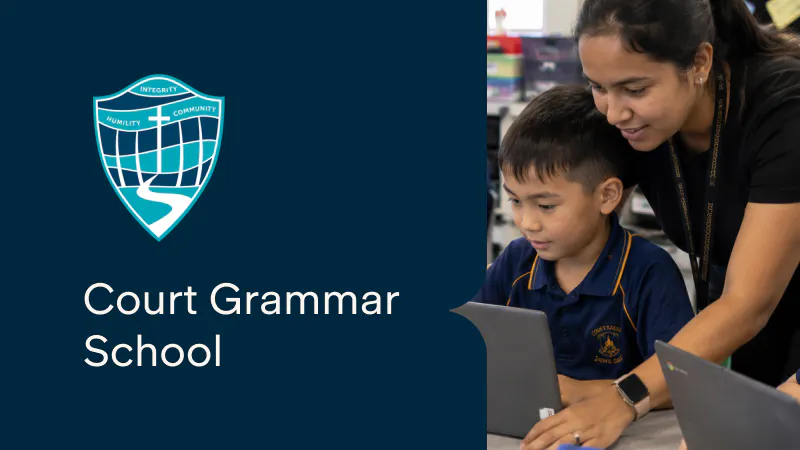
Court Grammar is an independent K–12 school in Western Australia with more than 1,200 students, including over 600 in the primary school.
Background
Under the leadership of Head of Primary Patricia McLoughlin, Court Grammar has focused on creating learning environments where every student has the opportunity to participate and demonstrate understanding.
As digital learning and research became increasingly important across the curriculum, the school began exploring how assistive technology could help remove barriers for students who found it difficult to access learning independently.
Read&Write has transformed how we support learning across our curriculum. It has truly created an inclusive, inquiry-driven environment where every student can thrive.
After seeing how assistive technology had transformed student independence in the international schools she had worked at, Patricia oversaw the rollout of Read&Write across the Court Grammar school system.

The challenge
Before introducing Read&Write, some students found it difficult to access learning independently .
Many had strong ideas and the ability to contribute, but barriers related to reading, language processing, decoding and sustained attention often meant they needed an adult sitting beside them to access lessons, instructions and learning materials.
We had some children who just couldn't connect with learning through the traditional practices. Such teaching environments required someone to always sit next to them to maintain a learning connection. We were looking for opportunities to help them be more independent.
As classroom learning increasingly required students to read, research and engage with digital content, those barriers became more visible.
For teachers and education assistants, providing constant one-to-one support created additional challenges.
“If you've got a class of 27 and one child needs one-to-one support as soon as you introduce a lesson, that can be stressful and frustrating for both the student and the teacher” says Patricia.
Patricia recognised that the challenge was not a lack of ability. “Our little ones who are in this position are great thinkers. They’re just not always given an opportunity to present that understanding because of the weight of language within the system.”
The school began looking for a way to give students more independent access to learning while allowing teachers and education assistants to support the wider classroom more effectively.
Why Read&Write?
Patricia had previously used assistive technology while working in international schools, where it helped students learning English as an additional language access learning more independently.
When she saw similar barriers affecting students at Court Grammar, she recognised the potential for assistive technology to provide another pathway to learning.
Before recommending a wider rollout, Patricia personally funded an initial Read&Write licence.
The school began with a small group of students and education assistants, using the trial period to evaluate the impact on learning, engagement and independence.
Following positive results, Read&Write was gradually embedded across the primary school before expanding to a whole-school licence.
Building confidence through independence
For Patricia, the most significant impact has been giving students access to support when they need it.
Students who previously relied heavily on adult assistance can now access learning more independently and participate more confidently in classroom activities.
One of our students didn't even want to come to school because he found it difficult to connect with learning due to language difficulties. Now, for the past two years, we haven't had an issue. He's turning up, engaging in class and showing what he can do.
Today, that same student uses Read&Write every day and is confident accessing support independently when needed.
"The student is happy and confident enough to ask for help or use his device unassisted,” says Astrid Schiller, Education Assistant at Court Grammar.
Patricia has also seen improvements in confidence, participation, resilience and engagement, with students more willing to attempt challenging tasks and contribute in class.
By helping students access support independently, Read&Write is helping them engage more fully with learning and demonstrate what they know.

The impact on teachers
Read&Write has not replaced teacher support. Instead, it has helped make support more scalable.
Students can access assistance independently in key moments, allowing teachers and education assistants to focus their attention where it is needed most.
“A teacher is able to do their job a little bit more efficiently with the whole class rather than one-on-one in those moments," Astrid says.
By creating another pathway to learning, Read&Write helps schools support a wider range of learners without increasing reliance on one-to-one intervention.
Families see the difference
Patricia says some of the clearest signs of success have come from families.
“When things go quiet, you don't even need to hear from a parent. You just know that it's working.”
As students become more confident and independent, families often become less anxious about their child's experience at school.
One family was so committed to helping their child embrace Read&Write that they encouraged older siblings to learn the platform as well, ensuring their younger brother would not feel isolated using it.
Creating a consistent approach to support
For Court Grammar, Read&Write forms part of a broader commitment to accessible learning.
Assistive technology can be incorporated into Individual Education Plans (IEPs), ensuring support follows students as they move through the school.
“It can be something that's noted on a child's learning plan, and naturally move with them through a K–12 system," explains Patricia.
The school now holds a whole-school licence and is beginning to see increased adoption as students progress into secondary school.
Advice for other schools
Looking back, Patricia recommends beginning with the curriculum before introducing any assistive technology.
"I'd look at your general capability skills and align those skills with the support Read&Write can offer."
By mapping assistive technology to curriculum capabilities and learning goals, schools can identify where tools like Read&Write support students to develop key skills while accessing learning more independently.
Schools can use the Australian Curriculum's General Capabilities, or the equivalent curriculum guidance in their state or territory, to identify opportunities to embed assistive technology in teaching and learning.
Patricia also recommends introducing technology gradually, giving staff time to build confidence and understand how assistive technology can support differentiated teaching while enabling student independence.
"It allows staff to explore new ways to support differentiated planning. It also helps them understand how assistive technology can support learning while still enabling students to develop their skills independently."

EDUCATION SOLUTION
Find out more about how Read&Write can support your students.