Adoption impact study
A proven model for statewide learning support at scale
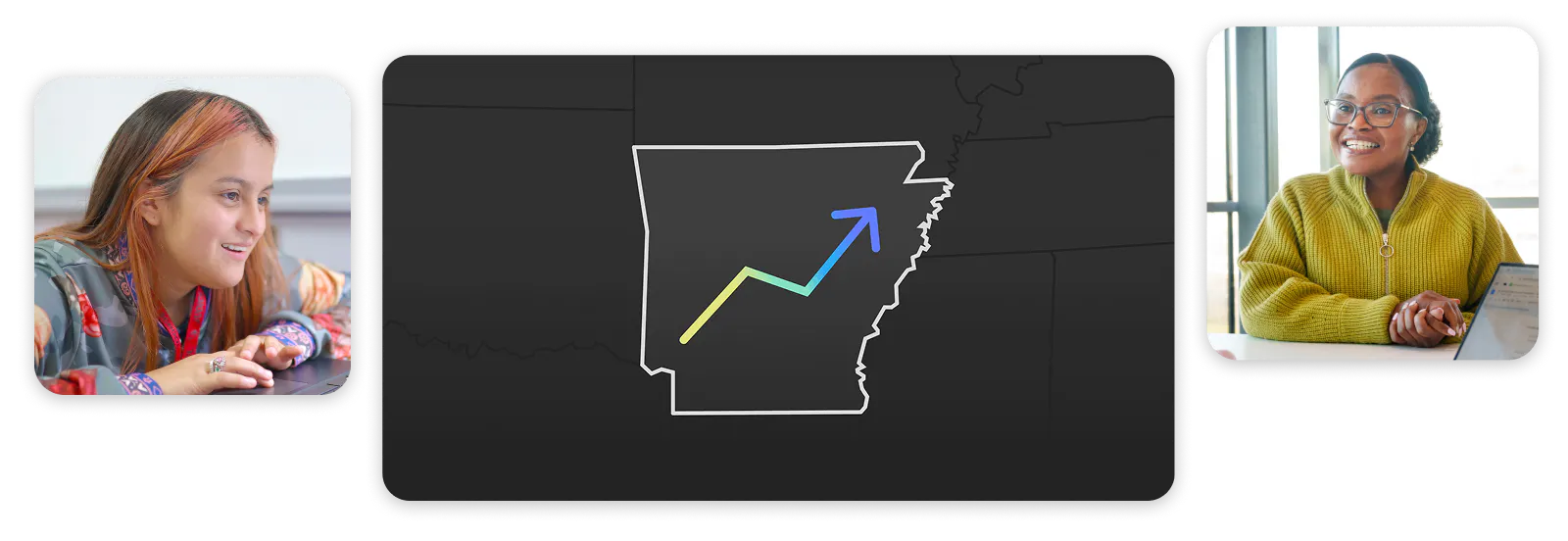
An independent study shows how Arkansas successfully scaled the adoption of statewide learning supports at unprecedented speed using Everway products.
The report
The evaluation focused on three core areas: access, engagement, and outcomes. It examined how a statewide software license influences technology use in and out of school, how students use Everway products within a multi-tiered support system, and how tool usage relates to student achievement.
We break down the results into three sections:
Proving the value of scale
Arkansas did what most large-scale rollouts struggle to do.
In most states, access to literacy and math software is uneven. District-by-district purchasing creates delays, widens gaps by geography and district size, and makes it hard to implement or evaluate supports consistently at scale.
Arkansas flipped the script. In 2023, the Arkansas Department of Education partnered with Everway to provide Read&Write, uPar, and Equatio statewide for grades 3–12, so every learner and educator could access supports without district-by-district purchasing.
This statewide model delivered immediate, barrier-free access without waiting for local procurement or onboarding. Shared professional learning and statewide data supported rapid rollout, visibility into reach and usage, and early analysis of student impact.

2. How universal access drove meaningful adoption

81%
districts used Read&Write monthly in 2024-2025

85%
districts used uPar monthly in 2024-2025

58%
districts used Equatio monthly in 2024-2025

Rapid access and adoption
Arkansas’s statewide approach resulted in a level of scale, consistency, and early impact that is unheard of in state-level education technology initiatives.
Statewide licensing removed common barriers to adoption, including budget constraints, procurement delays, and uneven onboarding. Centralized purchasing, aligned training, and always-on access accelerated time-to-value for educators and students across Arkansas.
As a result, adoption scaled at a pace unprecedented in large-scale EdTech initiatives:
- Arkansas surpassed adoption levels that typically take five or more years in comparable implementations within just two months.
- In 18 months, 93% of Arkansas school districts had adopted least one Everway product, delivering near-universal statewide reach.
- 100% of Educational Service Cooperatives (ESCs) showed active usage, confirming consistent engagement across regional support structures.
- Usage did not vary meaningfully by geography, district size, or student demographics, supporting claims that statewide licensing reduces access gaps.
Read&Write
Read&Write is a literacy support tool with features like text-to-speech, vocabulary tools, and study aids that support writing, comprehension, and independent learning.
- 81% of Arkansas districts used Read&Write monthly in the 2024-25 school year.
- 25% of Arkansas students use Read&Write monthly (well above the ~15% of students receiving special education services).
Maturity of implementation
- There is high usage of core features including text-to-speech, highlighter, and study tools.
- Study tools and highlighting are used at nearly the same level as text-to-speech, indicating active learning behaviors (analyzing, annotating, organizing), not only passive listening via text-to-speech.
- These Read&Write usage patterns show unusually mature implementation for a first phase.
Beyond the school day
- Read&Write is consistently used after school and on weekends, with the same top features used during instructional hours.
- Consistent use across classroom and home environments suggests continuity of learning behaviors across settings and sustained routines, rather than one-off accommodations.

Read&Write
Read&Write is a literacy support tool with features like text-to-speech, vocabulary tools, and study aids that support writing, comprehension, and independent learning.
- 81% of Arkansas districts used Read&Write monthly in the 2024-25 school year.
- 25% of Arkansas students use Read&Write monthly (well above the ~15% of students receiving special education services).
Maturity of implementation
- There is high usage of core features including text-to-speech, highlighter, and study tools.
- Study tools and highlighting are used at nearly the same level as text-to-speech, indicating active learning behaviors (analyzing, annotating, organizing), not only passive listening via text-to-speech.
- These Read&Write usage patterns show unusually mature implementation for a first phase.
Beyond the school day
- Read&Write is consistently used after school and on weekends, with the same top features used during instructional hours.
- Consistent use across classroom and home environments suggests continuity of learning behaviors across settings and sustained routines, rather than one-off accommodations.

3. Key findings & impact data
Student outcomes
Early findings show the clearest achievement signal in literacy, with consistent, statistically significant relationships between tool usage and district-level outcomes across grades and performance levels.
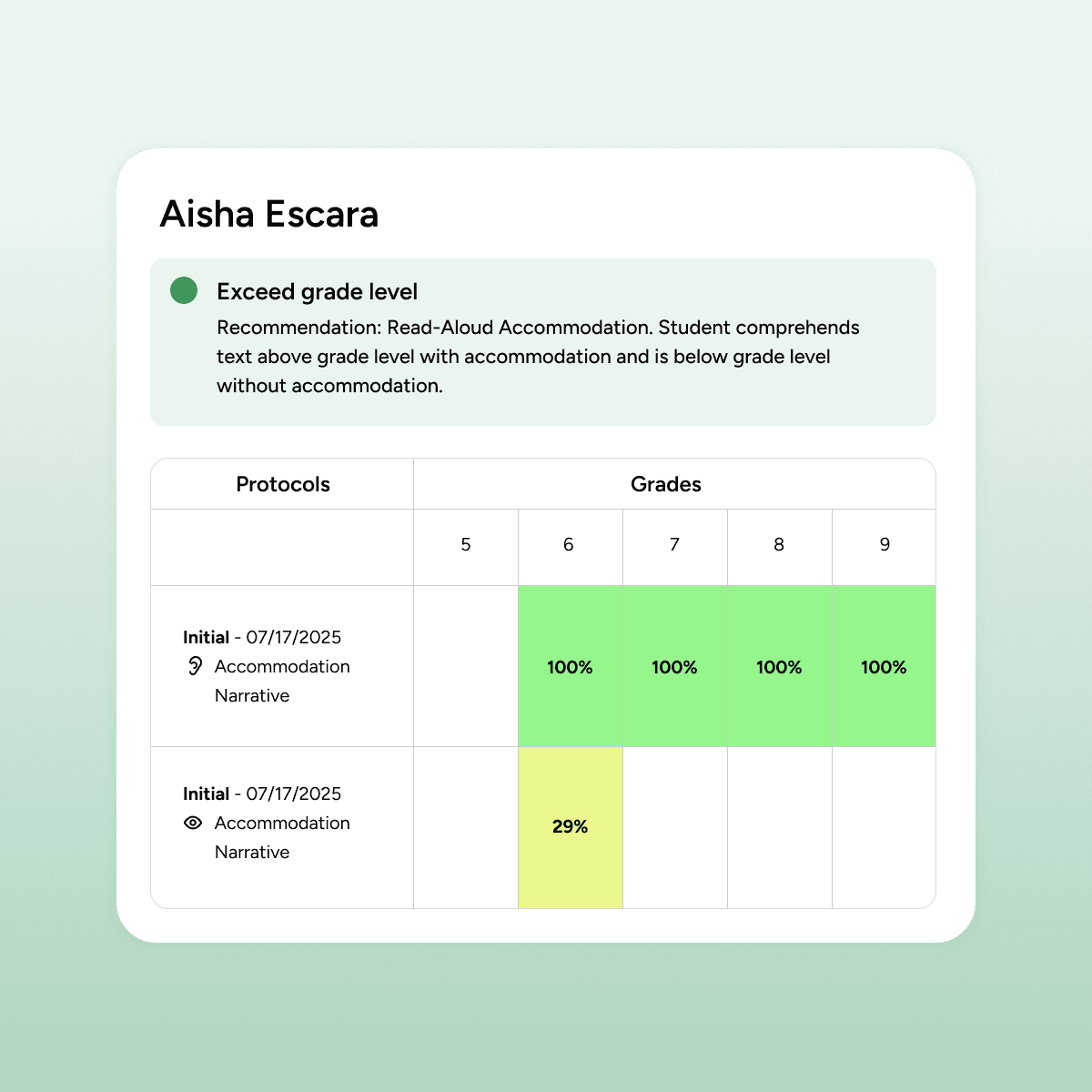
Taken together, Read&Write and uPar function as a coherent literacy support system, helping identify student needs and deliver matched supports. uPar also highlights a major access-to-comprehension opportunity through read-aloud.
Overall, universal Tier 1 access combined with screening is accelerating MTSS by enabling earlier identification, better-matched supports, and less trial and error for educators.

Read&Write
Higher Read&Write usage is associated with statistically significant, positive relationships with district-level ELA and Reading performance across multiple grades and achievement levels.
Coefficients (all statistically significant) for Levels 1-3 ranged from:
- Level 1 (limited understanding): 0.014 to 0.036
- Level 2 (basic understanding): 0.042 to 0.050
- Level 3 (proficient understanding): 0.030 to 0.031
Associations were strongest for Level 2, indicating that districts serving readers who are struggling more are using Read&Write more intensively.
Teachers perceive a strong, positive impact on readers and student independence, reporting increased confidence supporting struggling learners.
“Offers smarter and more personalized study tools, Supports students with IEPs, 504 plans, or neurodiverse learning needs, Provides accessible tools like text simplification and screen masking, Uses AI-powered features to simplify and personalize learning.”
Special Education Resource Teacher
Read&Write
Higher Read&Write usage is associated with statistically significant, positive relationships with district-level ELA and Reading performance across multiple grades and achievement levels.
Coefficients (all statistically significant) for Levels 1-3 ranged from:
- Level 1 (limited understanding): 0.014 to 0.036
- Level 2 (basic understanding): 0.042 to 0.050
- Level 3 (proficient understanding): 0.030 to 0.031
Associations were strongest for Level 2, indicating that districts serving readers who are struggling more are using Read&Write more intensively.
Teachers perceive a strong, positive impact on readers and student independence, reporting increased confidence supporting struggling learners.
“Offers smarter and more personalized study tools, Supports students with IEPs, 504 plans, or neurodiverse learning needs, Provides accessible tools like text simplification and screen masking, Uses AI-powered features to simplify and personalize learning.”
Special Education Resource Teacher
Replicate Arkansas' success
The Adoption Playbook combines on-the-ground input from teachers and administrators, state-level implementation lessons, and the independent study findings into one practical blueprint for your large-scale tool rollout.
Use its step-by-step guidance to:
- Align the right people early
- Set clear rollout expectations
- Run a consistent wide-scale launch across states, regions, districts, and schools
- Track straightforward metrics and checkpoints to spot gaps quickly, target support, and sustain usage over time
Safe and Secure
Our products provide the highest possible level of security for student, school/district and enterprise data.

CompliantCOPPA

CompliantFERPA

CompliantGDPR

CertifiedISO/IEC 27001

CompliantSOPPA