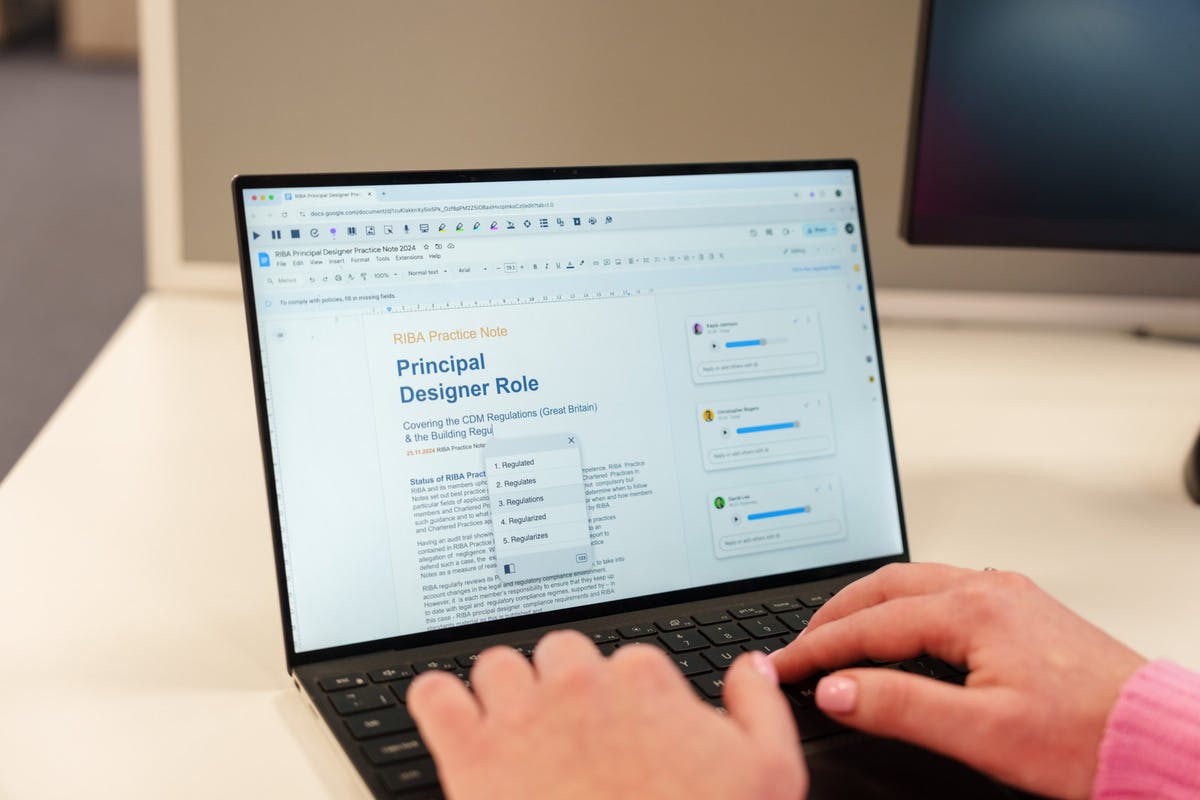

Explore key findings on word prediction and what they may mean for educators and leaders deciding how writing supports are used.
Word prediction suggests words as a student types. It is used to support writing when spelling or typing makes it harder to get ideas onto the page.
For some learners, the challenge is not what to say, but how to write it. Research in this area focuses on situations where spelling and writing effort interrupt thinking and sentence flow.
Studies most often show improvements in spelling accuracy, readability, and sentence-level writing. Some findings also suggest that reducing writing effort can help students stay focused on their ideas.
These findings are useful for K-12 and higher education leaders and educators making decisions about digital writing supports.
Settings where word prediction has been examined
Research studies describe several contexts in which word prediction is looked at. The strength of evidence varies across learner groups and settings.
1. When spelling makes it hard to express ideas
Word prediction is often used when students know what they want to say but struggle to spell words accurately. It helps reduce interruptions so they can focus on meaning and sentence flow.
2. When typing or writing takes too much effort
Some studies focus on students with physical disabilities. In these cases, word prediction helps reduce the effort of typing and supports clearer, more readable writing.
3. When writing breaks down at sentence level
Research looks at how word prediction affects sentence quality, not just spelling. This includes correct word sequences, syntactic accuracy, organization, and fluency.
4. When prediction is used with other writing supports
These studies examine how supports affect writing outcomes such as spelling accuracy, fluency, and overall writing quality.
5. Differences by learner profile and context
Most studies focus on students with physical disabilities, learning disabilities, or writing difficulties. Results suggest that benefits vary by student, task, and setting. Word prediction does not appear to affect all writing outcomes in the same way or to the same degree.
Key findings from the research
Research on word prediction highlights several consistent themes that are relevant for educators, school and district leaders, and higher education teams.
1. Word prediction can improve spelling accuracy
This is the most consistent finding across studies. Students using word prediction often produce more correctly spelled words than when writing by hand or using basic tools.
In a study of students with physical disabilities, the proportion of correctly spelled words increased from 67.27% during handwriting to 93.46% with Co:Writer. Legibility also increased from 70.83% to 96.94%. These are significant changes and suggest that, for some students, word prediction can reduce a major barrier to written expression.
Other studies with students with learning disabilities and writing difficulties report similar patterns. Their spelling improves and students are better able to produce readable text.
2. Word prediction can support sentence-level writing
In several studies, students also showed gains on measures related to writing quality. In one study, the proportion of correct word sequences increased from 50.45% with handwriting to 85.57% with Co:Writer, and the mean length of consecutive correct word sequences increased from 3.31 to 5.55.
These findings suggest that when spelling demands are reduced, some students may produce writing that is more accurate at the sentence level.
Other studies report improvement in syntax and organization, especially when word prediction is used alongside text-to-speech. This does not mean the feature automatically improves all higher-order writing skills, but suggests that reducing low-level writing effort can create more room for students to focus on structure and expression.
3. Word prediction may reduce frustration and support independence
Several studies and classroom reports describe positive changes in how students experience writing when word prediction is available. Students report that writing feels easier, and teachers and researchers describe reduced frustration and greater willingness to continue writing.
These findings should be interpreted carefully. In many cases, they are based on student or teacher perceptions rather than formal outcome measures.
However, they do suggest that the value of word prediction may not be limited to error reduction. For some learners, it may also make writing feel more manageable and less discouraging.
4. Effects on speed and quantity are mixed
Word prediction does not consistently lead to more words written or faster writing. Some studies found no significant difference in writing quantity. Others suggest that students may initially write more slowly as they learn how to use the prediction tool.
This helps set realistic expectations. The strongest evidence is in accuracy, legibility, and some aspects of sentence-level writing quality. Changes in speed or output may depend on experience, training, and the learner.
5. Benefits vary by student and context
Across studies, outcomes differ by learner profile, task, and context. Some students show improvements in spelling and writing quality, while other outcomes are mixed.
This makes word prediction less like a universal solution and more like a targeted writing support. It is most useful when a student’s main writing barrier is tied to spelling, transcription, or writing effort and not idea generation alone.
What this means for educators and leaders
This research points to a few practical questions for educators and leaders deciding when word prediction could be helpful for students.
- Word prediction can reduce barriers related to spelling and transcription
- It does not only improve spelling, but also helps students produce clearer, more readable writing
- The strongest findings relate to accuracy and readability, not necessarily writing speed or amount
- When spelling effort is reduced, some students may be better able to produce writing that is more accurate and readable at the sentence level
- Benefits vary depending on the learner and the writing context
- Word prediction is best understood as a writing access support, not a replacement for writing instruction
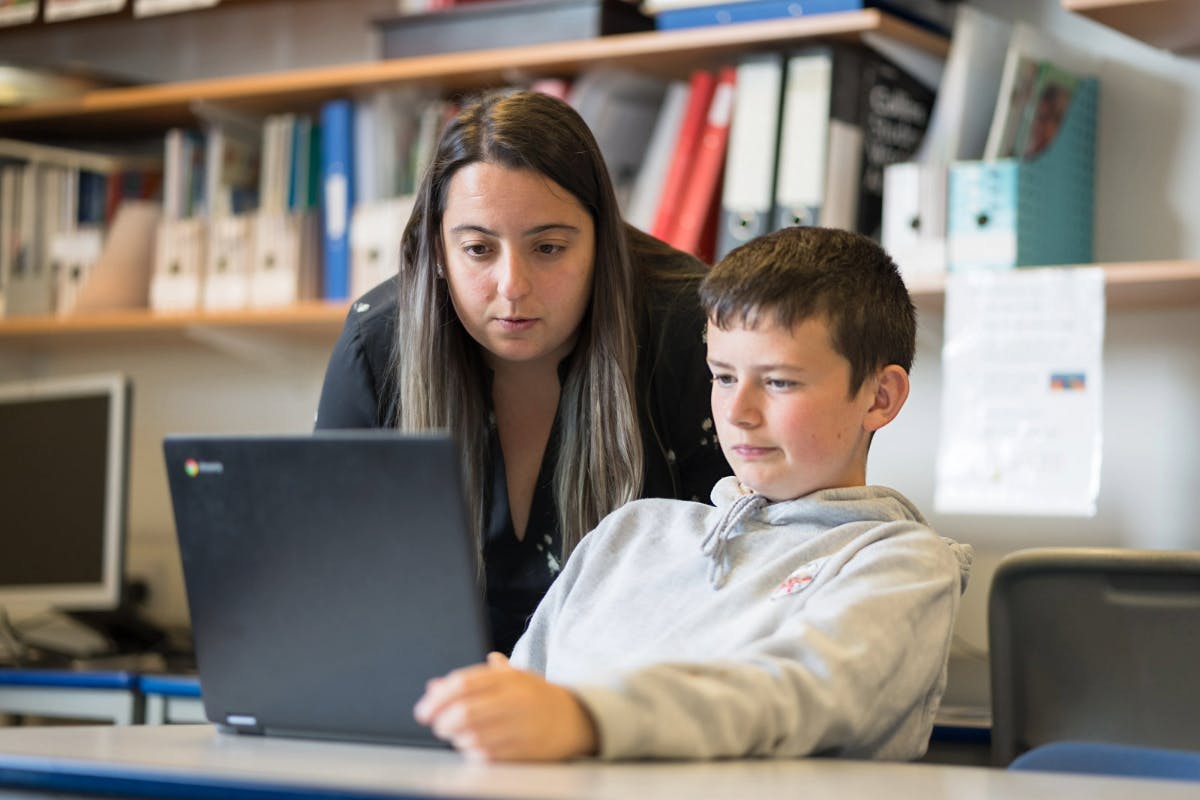
For school and system leaders, this matters when selecting inclusive writing features. The key question is not simply whether a student has writing difficulty, but what kind of writing difficulty is getting in the way.
If spelling, transcription, or the effort of producing text is the barrier, word prediction may play an important role.
How word prediction is commonly used in practice
Across education settings, several patterns appear in how word prediction is introduced and used in practice.
Practical takeaway | What to do and how |
|---|---|
Clarifying its role | Word prediction is used to support writing when spelling, typing or writing effort make it harder for students to express ideas clearly |
Supporting sentence-level writing | Students use suggested words to continue writing flow when spelling would otherwise interrupt the sentence |
Reducing low-level writing effort | Teachers use word prediction when the goal is to shift attention to idea generation, sentence construction, or revision |
Pairing with other supports | In some settings, word prediction is used alongside text-to-speech or speech feedback to provide auditory support during the writing process |
Reviewing use over time | Teachers monitor whether the tool is helping in the intended way, especially as student needs change |
Interpreting the research
Research on word prediction includes intervention studies, classroom-based studies, review articles, and perception-based findings.
Several points are important when interpreting these findings:
- Improvements in spelling accuracy are among the most consistent findings
- Gains in writing quality are present in some studies, but not all measures improve equally
- Reports of reduced frustration and increased independence are important, but often based on perception data
- Writing speed and total words written do not improve consistently across studies
- Many studies focus on specific learner groups, especially students with physical disabilities, learning disabilities, or writing difficulties
Overall, the research suggests that word prediction can lower writing barriers in specific situations. It does not show guaranteed improvement across all aspects of writing or across all learners.
- Mirenda, P., Turoldo, K., & McAvoy, C. (2006). The Impact of Word Prediction Software on the Written Output of Students with Physical Disabilities. Journal of Special Education Technology, 21(3), 5–12. https://doi.org/10.1177/016264340602100301.
- Handley-More, D., Deitz, J., Billingsley, F. F., & Coggins, T. E. (2003). Facilitating Written Work Using Computer Word Processing and Word Prediction. The American Journal of Occupational Therapy, 57(2), 139–151. https://doi.org/10.5014/ajot.57.2.139
- Cullen, J., Richards, S. B., & Frank, C. L. (2008). Using Software to Enhance the Writing Skills of Students with Special Needs. Journal of Special Education Technology, 23(2), 33–44. https://doi.org/10.1177/016264340802300203
- Evmenova, A. S., & Regan, K. (2019). Supporting the Writing Process with Technology for Students with Disabilities. Intervention in School and Clinic, 55(2), 78–85. https://doi.org/10.1177/1053451219837636
- Silió, M. C., & Barbetta, P. M. (2010). The Effects of Word Prediction and Text-to-Speech Technologies on the Narrative Writing Skills of Hispanic Students with Specific Learning Disabilities. Journal of Special Education Technology, 25(4), 17–32. https://doi.org/10.1177/016264341002500402
- Williams, S. C. (2002). How Speech-Feedback and Word-Prediction Software Can Help Students Write. Teaching Exceptional Children, 34(3), 72–78. https://doi.org/10.1177/004005990203400310