Neurodivergent employees are 55% more likely to use AI at work than their neurotypical colleagues. That figure comes from the EY Global Neuroinclusion at Work Study 2025 - the largest study of its kind, with over 2,000 professionals across 22 countries.
The AI tools most people use at work were built for scale, not for cognitive diversity. They assume there is one typical way to read, write, communicate, and organise work. For millions of neurodivergent employees, those assumptions do not reflect how they work best.
15-20% of the global workforce is neurodivergent today. This is not a niche. It is the largest workplace segment that generic AI does not consider.
What AI does well for neurodivergent users today
It takes tasks most people barely think about - reading a document, organising a day, getting thoughts into writing, understanding what someone actually means in an email - and makes them manageable.
Text-to-speech and voice input remove the mechanics of reading and writing for people with dyslexia or dyspraxia. Summarisation and plain-language tools help autistic users navigate indirect communication. Scheduling, task breakdown, and focus tools support executive function for people with ADHD.
These are not edge cases. This is daily life for a large number of people. When AI works well here, it is the difference between being able to show what you're capable of and having that potential hidden by unnecessary barriers.
Where generic AI falls short
The shortfalls follow from how the tools were built.
Most large language models were trained on data that reflects neurotypical patterns of communication. The models are less likely to work well for people who write differently, process information differently, or use language outside the training distribution. Speech recognition performs worse for atypical speech patterns. Tone checkers flag direct communication as rude.
Summarisers' default to a single compressed-text format. Useful for skim-readers, less so for people who need information reorganised by structure or visual layout. Writing tools assume the user already has their thoughts organised and just need the AI to clean up the wording. That is a usable starting point, but it does not help with the harder parts - tone, structure, clarity, knowing whether you have been understood.
Task tools often stop at task lists. They do not adapt to how different people work best. The challenge is often not capability, but structure. Knowing where to start, what to prioritise, and how to maintain momentum can make the difference between a task feeling manageable or overwhelming.
The risks of relying on consumer AI
There is a secondary problem. When generic AI tools do not consider neurodivergent users, people find their own ways to make them work. Running emails through a chatbot to check tone. Using voice assistants as an external memory. Turning to image generators because expressing an idea visually is easier than writing it down.
That ingenuity highlights both the potential of AI and the gaps that still exist. Workplace needs are being met by consumer tools that were never designed for them.
Those tools do not offer the same safeguards as purpose-built assistive technology. Data protection standards vary widely. They are rarely tested with neurodivergent users in mind, and supporting independence over the long term is not part of their design. If someone comes to rely on a consumer chatbot as part of how they work, they are depending on a tool with no obligation to remain available, accurate, or private in the way they need it to be.
The answer is not to stop using AI. It is to build AI that considers neurodivergent users from the start, with privacy, accessibility, and responsible design built into the architecture from day one.
Building for neurodivergent users starts with who is in the room
Making sure AI works for the full range of people who use it starts with understanding the people you're designing for. Building neuroinclusive AI is not just about the models you choose or the features you create. It is about the experiences, perspectives, and assumptions that shape every product decision.
That is the approach we've taken with Everway for Work. As AI adoption accelerated, we saw a growing disconnect between who was using the technology and who it was designed for. Neurodivergent employees were among the most active users, yet most AI tools reflected neurotypical assumptions about communication, organisation, and productivity.
Everway for Work was built to challenge that. It is co-designed with neurodivergent users by neurodiverse teams. Across the company, neurodivergent colleagues help design, build, and test the tools we create. That changes what we prioritise, what we build, and what we leave out.
This approach is rooted in our history. Our founder and Executive Chairman, Martin McKay, started the company 30 years ago after his father had a stroke. He saw first-hand how a lack of accessible technology could limit independence and opportunity, and set out to build tools that could help remove those barriers. His belief that technology should adapt to people still shapes how we build products today. Martin, who was later diagnosed with dyslexia as an adult, remains actively involved in product development.
It also addresses something I hear from customers: a quiet skepticism about products built for neurodivergent users by teams who are not part of that population. The scepticism is fair. Building truly neuroinclusive technology means including neurodivergent people throughout the design and development process.
Neuroinclusive AI & Everway for Work
Everway for Work is built around the challenges neurodivergent people encounter throughout the working day, and the support they need to overcome them.
Rather than treating reading, writing, planning, and productivity separately, we bring them together in a single experience. This reflects how work actually happens.
The first area is understanding and communicating information.
People need different ways to access, process, and respond to information. Everway for Work includes text-to-speech, dictation, translation, reading support, and AI-powered communication tools that help people understand content, summarise information, and communicate with greater clarity and confidence. These capabilities build on more than 30 years of experience creating tools for neurodivergent individuals.
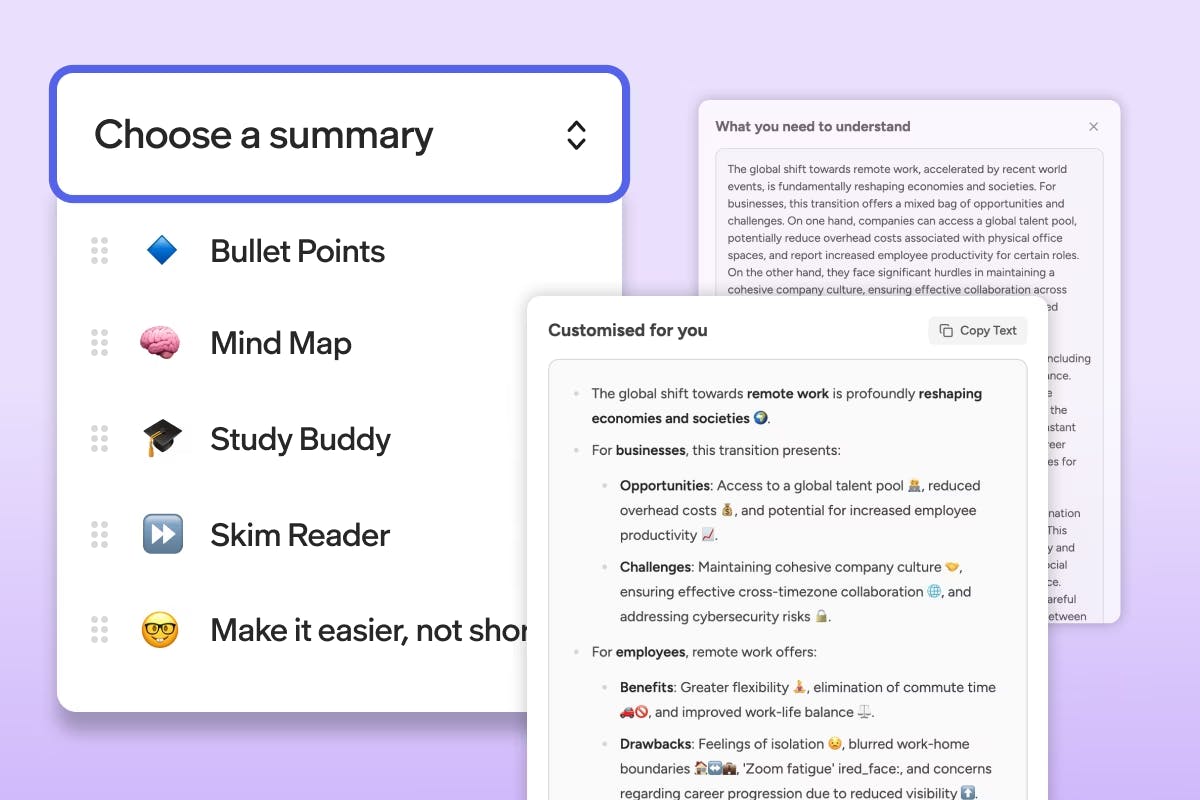
The AI features within this category include Summaries, which reshapes content into formats that suit different cognitive styles, and Refine, which rewrites messages in the tone the writer intends, particularly helpful for autistic professionals. Underlying these features is our neuroinclusive and responsible approach to AI. Both features run on Google Gemma 3, downloaded once to the user's device during setup. No content is sent externally for AI processing. The AI runs locally, and the user keeps the data.
The second area is planning and organising work.
Many people think best when they can explore ideas freely before turning them into structured output. Everway for Work supports visual thinking, helping users capture ideas into mind maps, organise information, make connections, and transform early thoughts into documents, presentations, project plans, and other work outputs.
This is helpful for dyslexic employees, who often think best visually. As well as ADHD thinkers who benefit from tools that create structure from free thinking.
The third area is focusing and getting work done.
Starting work, maintaining momentum, managing priorities, and staying focused are common challenges for many employees. Everway for Work includes tools designed to reduce friction, support motivation, and help people manage workload in ways that work for them. Its task management tools are designed for how neurodivergent minds, particularly ADHD thinkers, stay engaged. Users can rate tasks by interest. The product uses dopamine-based prompts, ambient sound for focus, breathing techniques to reset, calendar integration, and time blocking.
Three principles underneath the products
- Privacy by design. Our AI architecture is designed so AI components avoid accessing or retaining identifiable personal data. Where data must pass through a model, redaction and pseudonymisation are the design standard. This is documented in our Responsible AI & Data Protection Framework, published publicly. I would urge anyone evaluating AI tools for neurodivergent users to ask hard questions about data handling. The answers vary enormously across the market.
- Human oversight. AI in our products is assistive. It suggests, surfaces, and helps the user do the work. The user decides what to use. The goal is building capability over time, with AI as scaffolding the user can step away from when they no longer need it.
- Cognitive accessibility, first. AI is one of the tools we use to reduce cognitive friction. The aim is for people to do their actual work more easily.
This is what it looks like when AI is built by the people who use it. On architecture that respects their data. In service of how they actually work. Everway for Work is the product we have today. The work continues.
Discover more
Virtual event | October 6 | Free
Register for our upcoming event for our session Beyond one-size-fits-all: Aligning AI and workplace technology to cognitive needs.
We’ll explore how neuroinclusive technology and AI can reduce friction, support different ways of thinking, and help people do their best work.